Turkey has established itself as one of the most attractive real estate destinations for international investors, retirees, and families seeking residency or long-term capital growth. Thanks to transparent property laws, modern infrastructure, and straightforward acquisition procedures, foreign nationals can legally purchase residential, commercial, and land assets across most of the country. However, successfully completing a transaction requires a clear understanding of the statutory conditions and careful preparation of official paperwork.
Whether you are purchasing a seaside apartment in Antalya, a commercial unit in Istanbul, or a villa in Bodrum, adhering to Turkish Land Registry regulations protects your investment and prevents unnecessary delays. Below is a comprehensive breakdown of the legal eligibility rules, required documentation, financial steps, and transfer procedures for property ownership in Turkey.
Legal Conditions for Real Estate Ownership in Turkey
Foreign property acquisition in Turkey is primarily governed by Article 35 of the Land Registry Law No. 2644. Following major legislative reforms in 2012, Turkey abolished the strict reciprocity principle, opening the property market to citizens of most countries worldwide. Nevertheless, several legal limitations and conditions remain in force to safeguard national security and urban planning.
Nationality Eligibility and Restrictions
Citizens of over 180 countries are permitted to buy real estate in Turkey in their own names. However, nationals of a very small number of countries—most notably Syria and North Korea—are currently restricted from acquiring property directly as individuals. Additionally, citizens of neighboring countries such as Greece, Russia, and Ukraine may face specific regional restrictions in certain coastal or border provinces, depending on evolving cabinet decrees.
Area Limits and Land Allocation Rules
Turkish law imposes clear quantitative caps on foreign land ownership:
- Individual Limit: A foreign natural person may purchase a maximum of 30 hectares (300,000 square meters) of real estate across the entire country.
- District Limit: Total foreign-owned property within any single district (ilçe) cannot exceed 10 percent of the total privately owned land area in that district.
- Agricultural or Unbuilt Land: If a foreigner purchases land without an existing building on it, they must submit a development project to the relevant Ministry within two years of acquisition and obtain approval.
Military and Security Zones
Foreign nationals are prohibited from purchasing properties located inside designated military forbidden zones or strategic security areas. Before any title deed transfer is finalized, the Land Registry Office verifies that the parcel falls outside restricted coordinates, although many urban districts have already been pre-cleared to speed up standard residential transactions.
Looking for a reliable real estate platform to sell your property quickly and transparently?
EmlakPlatform is not just an option, it is the smart solution for you. We combine advanced technology, full transparency, and professional support
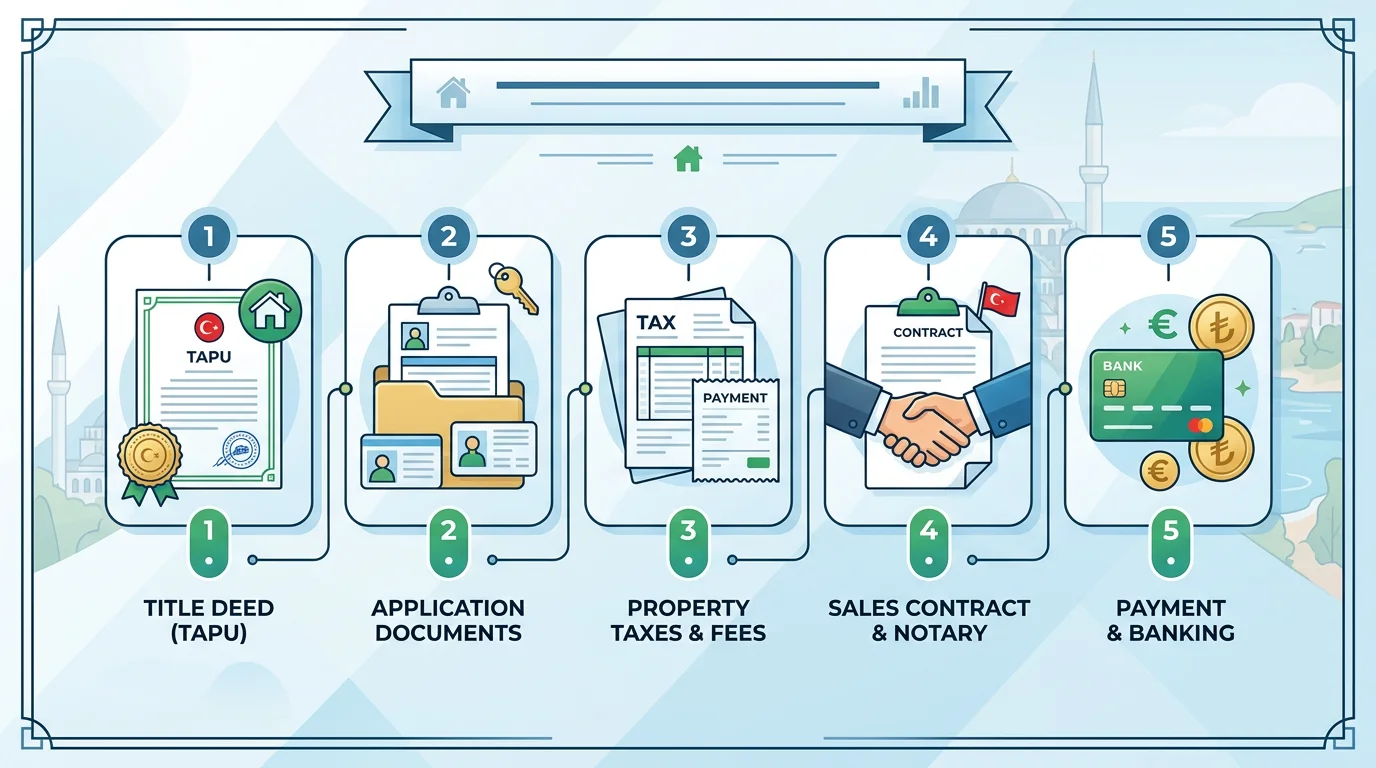
Essential Documents Required to Buy Real Estate in Turkey
Preparing your paperwork before visiting the General Directorate of Land Registry and Cadastre (Tapu ve Kadastro Genel Müdürlüğü) ensures a smooth and legally compliant closing. Both the buyer and the seller must submit specific documents, and any foreign-language paperwork must be translated by a sworn translator and notarized in Turkey.
1. Valid Passport and Notarized Translation
The foreign buyer must present their original passport, which should be valid for at least six months, along with two copies translated into Turkish and certified by a Turkish notary public (Noter). If you are acting through a representative, a notarized Power of Attorney (Vekaletname) issued either at a Turkish notary or a Turkish consulate abroad is required.
2. Turkish Tax Identification Number (Vergi Numarası)
Every foreign buyer must obtain a Turkish Tax Identification Number before opening a bank account, paying transfer taxes, or registering a title deed. This number can be acquired free of charge within minutes at any local tax office or online through the Turkish Revenue Administration's Interactive Tax Office portal using your passport details.
3. Property Appraisal Report (Ekspertiz Raporu)
To prevent under-declaration of property values and protect foreign buyers from inflated pricing, the Turkish government mandates an official real estate valuation report prepared by a licensed appraiser certified by the Capital Markets Board (SPK). The report confirms the fair market value, zoning status, and physical compliance of the property, and remains valid for three months from the date of issue.
4. Currency Purchase Certificate (Döviz Alım Belgesi - DAB)
Under Central Bank regulations introduced to strengthen foreign currency reserves, foreign buyers must convert the property purchase price from a foreign currency (such as USD, EUR, or GBP) into Turkish Lira through a licensed Turkish bank prior to the title deed transfer. The bank issues a Currency Purchase Certificate (DAB), which must be submitted directly to the Land Registry Office as proof of payment conversion.
5. Compulsory Earthquake Insurance (DASK)
DASK (Doğal Afet Sigortaları Kurumu) is mandatory earthquake insurance for all residential and commercial buildings in Turkey. Even if the seller holds an active policy, it must be valid on the day of the Tapu transfer or renewed in the buyer's name immediately.
6. Biometric Photographs and Identity Forms
The buyer must provide two recent biometric photographs (size 4x6 cm, taken within the last six months), while the seller provides one photograph. Additionally, the Land Registry Identity Declaration Form must be completed accurately.
7. Seller's Property Documentation
The current owner or developer must present the existing Title Deed (Tapu), their Turkish national ID or passport, and a "No Tax Debt" certificate (Rayiç Bedel Belgesi) obtained from the local municipality confirming that all annual property taxes have been settled and showing the municipal base value of the unit.
Summary of Requirements and Key Procedures
The following table summarizes the core conditions, mandatory documents, issuing authorities, and validity criteria involved in foreign real estate acquisition in Turkey.
| Requirement / Document | Purpose | Issuing Authority | Key Condition / Validity |
| Passport & Translation | Buyer identification | Home Country / Turkish Notary | Must be notarized in Turkish |
| Tax ID Number | Tax & banking registration | Turkish Tax Office | Mandatory before opening bank account |
| Appraisal Report (Ekspertiz) | Confirms true market value | SPK-Licensed Valuer | Valid for 3 months |
| Currency Certificate (DAB) | Proof of foreign exchange sale | Turkish Commercial Bank | Required before Tapu appointment |
| Earthquake Insurance (DASK) | Mandatory building coverage | Licensed Insurance Agency | Must be active at transfer |
| Municipal Valuation (Rayiç) | Tax clearance & minimum value | Local Municipality | Zero unpaid property tax required |
| Individual Land Cap | Statutory ownership limit | Land Registry Law No. 2644 | Maximum 30 hectares nationwide |
Step-by-Step Title Deed Transfer Process
Once all documents are gathered, the actual transfer of ownership follows a structured sequence supervised by state officials:
- Due Diligence and Sales Contract: Verify through the Land Registry Office that the property has no mortgages, liens, foreclosures, or legal disputes. Sign a clear bilateral sales agreement outlining the price, payment schedule, and handover date.
- Bank Transfer and DAB Issuance: Transfer the purchase funds into your Turkish bank account, instruct the bank to convert the foreign currency into Turkish Lira for real estate purchase, and collect the official DAB document.
- Online Tapu Application: Submit all scanned documents through the Web-Tapu portal to request a transfer appointment. The Land Registry will calculate the exact title deed tax and issue an SMS payment reference.
- Tax Payment and Final Signing: Pay the transfer fees at an authorized state bank. On the appointment day, both parties (along with a sworn translator if the buyer does not speak Turkish) sign the official ledger at the Land Registry Office, and the new Title Deed (Tapu) is printed and handed to the buyer immediately.
Additional Costs, Taxes, and Ownership Rights
Beyond the agreed property price, buyers should budget for transactional fees and understand the immigration benefits tied to property investment:
- Title Deed Transfer Tax (Tapu Harcı): Officially set at 4 percent of the declared property value. While the law splits this 2 percent each between buyer and seller, market custom frequently requires the buyer to cover the full 4 percent unless negotiated otherwise.
- Revolving Fund Fee (Döner Sermaye): An administrative fee paid to the Land Registry Office, adjusted annually and slightly higher for foreign buyers.
- Notary, Translation, and Appraisal Fees: Modest fixed costs covering sworn translations, certified interpreter attendance at the Tapu office, and the SPK valuation report.
- Residency and Citizenship Pathways: Owning residential property valued at a minimum of $200,000 USD generally qualifies foreign owners to apply for a renewable short-term real estate residence permit. Investors purchasing property worth at least $400,000 USD—subject to a three-year no-sale annotation on the Tapu—may apply for Turkish Citizenship by Investment for themselves, their spouse, and dependent children under 18.
FAQs : Conditions and Documents for Real Estate Ownership in Turkey
Yes. You can authorize a trusted lawyer or representative in Turkey using an official Power of Attorney (Vekaletname). This document can be drafted and notarized at the nearest Turkish Embassy or Consulate in your home country, or via an apostilled local notary depending on your country's bilateral agreements with Turkey. Opening a Turkish bank account is strongly recommended and practically essential because the Currency Purchase Certificate (DAB) must be issued by a bank operating in Turkey. Furthermore, having a local bank account simplifies paying utility bills, annual property taxes, and monthly residential maintenance fees. Once all required documents—including the appraisal report, DAB certificate, and municipal clearance—are submitted through the Web-Tapu system, the entire transfer process typically takes between 3 to 7 business days. On the day of the appointment, the physical title deed is handed over within the same hour. A Red Title Deed (Kırmızı Tapu) is issued for properties with existing residential or commercial buildings, representing ownership of an independent unit or condominium. A Blue Title Deed (Mavi Tapu) is issued for plots of land or agricultural fields without completed construction zoning. No, ownership alone does not grant automatic immigration status. However, property owners can apply separately for a residence permit if the property meets the current minimum valuation threshold ($200,000 USD for residential real estate), or apply for Turkish Citizenship by Investment if their qualifying real estate purchase equals at least $400,000 USD and meets all legal criteria.