Property Management in Georgia for Foreign Investors and Rental Income
Learn about property management in Georgia for foreign investors, including rental management, property oversight, and ways to maintain steady rental income.

Property management in Georgia for foreign investors and rental income has become an important part of the real estate investment strategy, especially with investors' interest in residential properties in Tbilisi and other Georgian cities.
The success of an investment is not limited to purchasing the property; it also depends on selecting tenants, following up on maintenance, managing contracts, collecting rents, and monitoring expenses.
Therefore, property management in Georgia represents a fundamental element in preserving the property's value and improving cash flows. An investor who does not reside in Georgia can also rely on specialized property management services in Tbilisi to reduce the need for daily follow-up.
This guide provides a practical overview of property management for foreign investors in Georgia, the mechanism of renting properties in Georgia, and the factors affecting rental income and rental yield in Georgia.
It also covers essential tax aspects, including rental income tax in Georgia, with a focus on investors wishing to invest in real estate in Georgia as foreigners or invest in real estate in Tbilisi.
Property Management in Georgia for Foreign Investors
Managing a property owned by a foreign investor differs from managing a property where the owner resides nearby. A non-resident investor usually needs a local entity or manager to handle daily operations, monitor the unit's condition, and deal with tenants and service providers.
Remote Property Management in Georgia
Managing a property in Georgia can include a range of tasks, such as:
- Monitoring the property's condition and conducting periodic inspections.
- Searching for potential tenants and verifying their data.
- Preparing and following up on lease agreements.
- Collecting payments and following up on arrears.
- Coordinating maintenance and repair work.
- Dealing with cleaning companies and various services.
- Preparing periodic reports for the owner on revenues and expenses.
- Following up on handover and takeover procedures when changing tenants.
These services become even more important when the investor owns multiple units or resides outside Georgia.
Property Management for Foreign Investors in Georgia
The foreign investor should define the scope of the property manager's services from the outset. Some companies offer full management, while others limit their services to finding tenants or collecting rent.
It is important that the management contract clearly includes the commission value, the services covered, the mechanism for approving repairs, expense responsibility, and the method of transferring revenues to the owner.
Property Management in Tbilisi and Its Role in Improving Rental Income
Tbilisi is considered a main hub for the demand for residential and investment properties in Georgia. Therefore, property management in Tbilisi is directly linked to the investor's ability to maintain occupancy and achieve stable revenues.
Property Management in Tbilisi for Foreign Investors
For an investor living outside Georgia, local management can include:
- Receiving new tenants.
- Inspecting the unit before and after the rental period.
- Following up on breakdowns.
- Organizing maintenance operations.
- Managing payments.
- Updating the owner on the property's condition.
- Assisting in re-renting the unit after the contract expires.
A property manager should not be evaluated based on commission alone; the cheapest management may not be the best option if it leads to longer vacancy periods, poor maintenance, or problems in rent collection.
Renting Apartments in Tbilisi
When renting apartments in Tbilisi, the area should be carefully evaluated in terms of demand level, proximity to metro stations and transportation, universities, and business and service centers. The apartment's size, finishing quality, furniture, building condition, and heating also affect the rental value and the speed of finding a tenant.
2026 data indicates a clear disparity between areas; some premium areas have recorded higher rents, while other areas offer lower purchase prices and more attractive rental yields. Therefore, it is advisable to compare similar recent properties before setting the price, rather than relying solely on the seller's or developer's estimates.
Rent Management in Georgia
Rent management in Georgia helps reduce operational risks and improve tenant follow-up, maintenance, and collection, especially for foreign investors. However, demand levels, rents, and occupancy rates vary depending on the area, property type, and season.
2026 data indicates a continued demand for properties suitable for long-term rental in Tbilisi, with varying performance across areas. Therefore, it is advisable to build financial expectations based on conservative, moderate, and optimistic scenarios, accounting for vacancy periods and management and maintenance costs, instead of assuming full occupancy throughout the year.
Rental Income in Georgia and Calculating Real Estate Investment Return
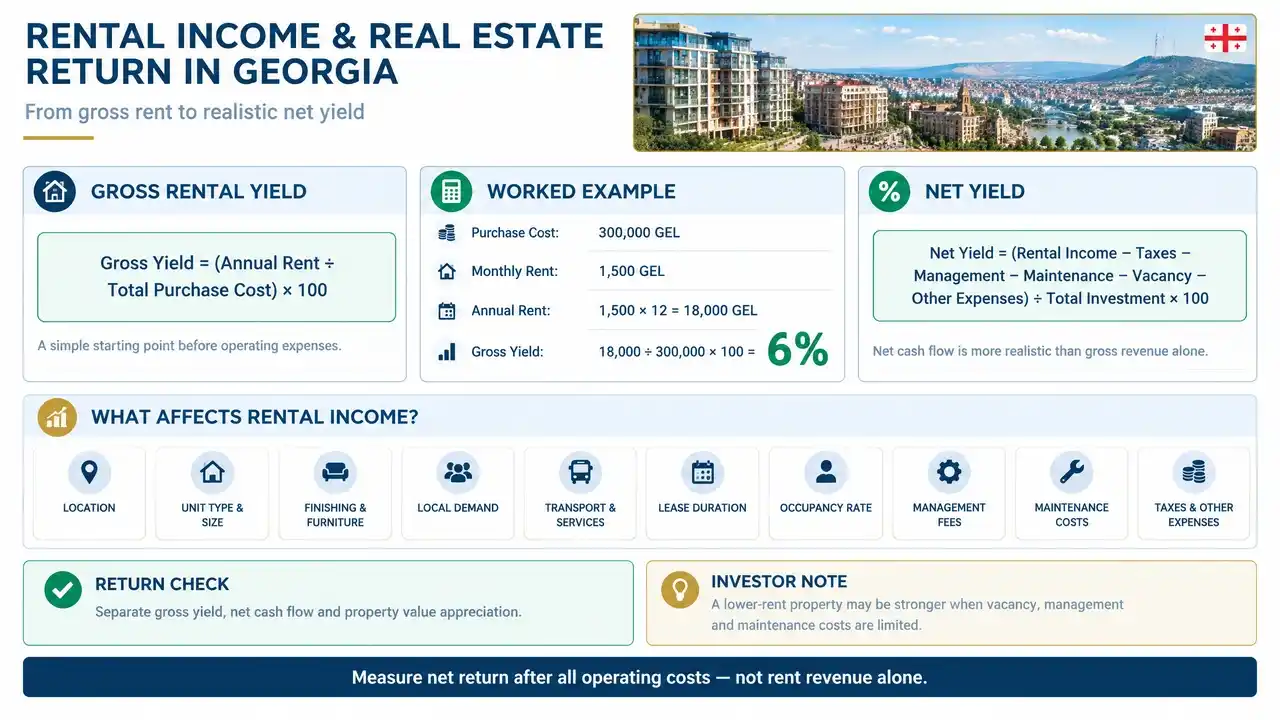
Rental income in Georgia represents a key factor when evaluating properties intended for investment and achieving periodic cash flows. However, total revenue does not reflect the investor's actual profit, as taxes, management fees, maintenance, vacancy periods, and other operating expenses must be calculated to determine the net yield more accurately and realistically.
Rental Yield in Georgia
The gross yield can be calculated simply using the following equation: Gross Rental Yield = (Annual Rent ÷ Total Property Purchase Cost) × 100. For example, if the total property purchase cost is 300,000 GEL, and the monthly rent is 1,500 GEL: Annual Rent = 1,500 × 12 = 18,000 GEL.
Thus: Gross Yield = 18,000 ÷ 300,000 × 100 = 6%. However, this percentage does not take into account taxes, vacancy periods, management fees, maintenance, insurance, or other expenses.
Real Estate Investment Return in Georgia
Therefore, the real estate investment return in Georgia must be measured more comprehensively, such as: Net Yield = (Rental Income − Taxes − Management − Maintenance − Vacancy − Other Expenses) ÷ Total Investment × 100.
It is also important to separate gross yield, net cash flow, and property value appreciation. A property with lower rent may be more attractive if the vacancy rate is low and management and maintenance costs are limited.
What Affects Rental Income?
Property income is affected by several factors, the most prominent of which are:
- Property location.
- Unit type and size.
- Quality of finishing and furniture.
- Level of local demand.
- Proximity of the property to transportation and services.
- Lease duration.
- Occupancy rate.
- Property management fees.
- Maintenance costs.
- Taxes and expenses associated with the property.
Looking for a reliable real estate platform to sell your property quickly and transparently?
EmlakPlatform is not just an option, it is the smart solution for you. We combine advanced technology, full transparency, and professional support
Renting Properties in Georgia and Tax Obligations
The tax aspect represents a fundamental element in evaluating an investment, especially for non-resident investors. The Georgian Revenue Service clarifies that rental income is included in the types of income used in certain tax liability calculations for individuals, while the Tax Code specifies different rates depending on the nature of the income.
Rental Income Tax in Georgia
According to Article 81 of the Georgian Tax Code, the income of a natural person resulting from renting residential space for residential purposes, without making deductions from this income, is subject to a rate of 5%.
The law also stipulates a 5% rate for certain types of income resulting from providing apartments or houses under the conditions specified in the same article. This means that the investor should not be satisfied with calculating the annual rent alone, but must include the tax obligation in the financial return model.
Is There a Property Tax?
The Georgian Revenue Service clarifies that property tax is linked to properties located within Georgia, and there are specific rules for determining the obligation for individuals and families.
Rental revenues are used within income data in property tax calculations according to the applicable rules. Therefore, a distinction must be made between rental income tax and any obligation related to property tax, as they are not the same tax.
Real Estate Investment in Georgia for Foreigners
A foreign investor can enter the Georgian real estate market, but must pay attention to the nature of the property and the associated land, especially when it comes to agricultural land, which is subject to special rules and restrictions on foreign ownership.
Georgian legislation clarifies the existence of a special system related to the ownership of agricultural land. Therefore, before purchasing any property, the ownership status in the public registry should be examined, and the nature of the land and the legal status of the property should be verified.
Real Estate Investment in Tbilisi and Achieving Sustainable Rental Income
Real estate investment in Tbilisi should not be based solely on expectations of price increases. An investor targeting periodic income needs to study rental demand, operating costs, and the appropriate strategy for managing the unit.
Real Estate Investment in Georgia for Arabs
For Arab investors, the ease of remote management and communication in an appropriate language can be important factors when choosing a property management company. Before purchasing a property, it is preferable to verify:
- The title deed and legal status.
- The nature of the property's use.
- Ongoing fees and expenses.
- Maintenance costs.
- The property's rentability.
- The level of demand in the area.
- The mechanism for transferring rental income.
- The management company's fees.
- Tax obligations.
How Does an Investor Choose a Property Management Company?
A management company can be evaluated through a set of criteria, the most important of which are:
- Local expertise: Knowledge of the market, areas, and tenants.
- Financial transparency: Providing a clear statement of revenues and expenses.
- Responsiveness: The ability to deal with breakdowns and tenant problems.
- Maintenance management: Having a reliable network of service providers.
- Reports: Providing regular reports on the property's condition and rents.
- Contract: Clearly defining services, commissions, and authorities.
A Practical Strategy for the Foreign Investor
An effective management strategy can be built on four stages:
- Before purchase: Analyzing the location, property price, and expected rent.
- After purchase: Preparing the property and defining the rental strategy.
- During rental: Following up on rents, maintenance, and occupancy.
- Annually: Reviewing net yield, taxes, costs, and property value.
In this way, property management in Georgia transforms from a mere operational service into a part of the investment strategy itself.
Table of the Most Important Elements of Property Management and Rental Income
| Element | What the Investor Should Follow Up On | Its Impact on Investment |
| Property Purchase Price | Comparing the price with similar properties | Determining the investment cost |
| Location | Demand, services, and transportation | Impact on rent and occupancy |
| Monthly Rent | Comparing local prices | Determining revenues |
| Occupancy Rate | Number of months rented annually | Impact on actual income |
| Property Management | Commission and scope of services | Impact on net yield |
| Maintenance | Periodic repairs and emergencies | Reducing cash flow |
| Taxes | Applicable tax obligations | Determining net income |
| Property Condition | Finishing, furniture, and facilities | Impact on rentability |
| Lease Agreement | Duration, conditions, and payments | Reducing dispute risks |
| Net Yield | Revenues after expenses | Measuring actual performance |
Frequently Asked Questions: Property Management in Georgia for Foreign Investors and Rental Income
Yes, a foreign investor can delegate operational tasks to a local property management company or property manager, with the powers, fees, reporting procedures, and financial transfer arrangements clearly specified in a written contract.
It can be suitable for investors seeking rental income, but its viability depends on the purchase price, property location, expected rent, occupancy rate, costs, taxes, and property management fees.
The Georgian Tax Code provides for a 5% tax rate on income earned by an individual from leasing residential space for residential purposes when no deductions are made from this income, subject to the conditions specified by law.
It is not mandatory simply because the investor owns a property, but it can be highly practical for an investor living outside Georgia, particularly when it comes to collecting rent, handling maintenance, and dealing with tenants.
The calculation starts by dividing the annual rental income by the total investment cost and multiplying the result by 100. For a more accurate assessment, taxes, management fees, maintenance costs, vacancy periods, and other expenses should be deducted before calculating the net yield.
Conclusion: Property Management in Georgia for Foreign Investors and Rental Income
Property management in Georgia for foreign investors and rental income clarifies that investment success does not depend solely on purchasing the property, but on continuous management and achieving a balance between revenues, costs, and risks.
Property management in Georgia, and especially property management in Tbilisi for foreign investors, helps deal with renting, maintenance, and tenants when the owner is outside the country.
Furthermore, when studying rental income in Georgia and real estate investment return in Georgia, taxes, vacancy periods, management fees, and operating expenses must be calculated instead of relying on gross yield alone.
Real estate investment in Georgia for foreigners remains a decision that requires legal and financial due diligence of the property before purchase, along with a review of the tax and regulatory rules in force at the time of investment.