Real Estate Taxes in Turkey for Foreign Investors
Learn about property taxes in Turkey for foreign investors, including purchase, ownership, and resale taxes, plus available tax exemptions and costs.

This article, titled "Real Estate Taxes in Turkey for the Foreign Investor," aims to provide an expanded and accurate explanation of everything related to real estate tax in Turkey, from the moment of considering a purchase through the stages of ownership, leasing, and resale.
This guide comes in light of the 2026 real estate tax updates in Turkey, which confirmed the continued stability of the tax system with the uniform application of laws to Turks and foreigners without any tax discrimination.
The article includes a detailed explanation of real estate taxes in Turkey for foreigners, a full clarification of property ownership tax in Turkey, and a comprehensive analysis of real estate fees in Turkey and the additional costs that investors must calculate accurately before making a decision.
It also covers practical aspects such as the tax on buying property in Turkey, the tax on selling property in Turkey, and how to benefit from tax exemptions for properties in Turkey, along with a comprehensive understanding of the impact of real estate investment in Turkey and taxes on long-term investment returns.
What is Real Estate Tax in Turkey and Its Main Types?
Real estate tax in Turkey is a government system imposed on property ownership, sales, purchases, and leasing. It includes several types such as annual property tax, purchase tax, and sales tax. These vary depending on the type of property and its location and are considered an essential part of the costs of real estate investment in Turkey for foreign investors.
Basic Real Estate Tax in Turkey
Real estate tax in Turkey is part of a comprehensive legal system subject to the Turkish Real Estate Tax Law (Law No. 1319), which imposes taxes on all types of properties such as apartments, land, and buildings.
This system does not distinguish between local and foreign investors. Recent laws indicate that property ownership is subject to the same rules regardless of nationality. This tax covers several stages:
- At the time of purchase.
- During ownership.
- During leasing.
- At the time of sale.
This makes understanding the system necessary for any investor entering the Turkish market.
Real Estate Taxes in Turkey for Foreigners
Real estate taxes in Turkey for foreigners are applied in the same way as they are for Turkish citizens, without any additional fees based on nationality. This factor is considered one of the most important reasons for attracting foreign investment, as Turkey adopts the principle of tax equality in the real estate sector. However, foreign investors need some additional administrative procedures such as:
- Obtaining a tax number.
- Opening a local bank account.
- Registering the property at the Land Registry Office (Tapu).
However, these procedures do not affect the value of the taxes themselves.
Property Ownership Tax in Turkey
Property ownership tax in Turkey is imposed annually on all registered properties. It is calculated based on the estimated value of the property by the municipality, not on the actual purchase price. The rate varies depending on:
- Type of property (residential or commercial).
- Location of the property (major city or ordinary area).
This tax is considered relatively low compared to European countries, making the Turkish market attractive to investors. Discover the steps to buy property in Turkey for foreign investors, your practical guide to understanding purchase, ownership, and sales taxes and ownership fees step-by-step before making an investment decision with confidence.
Purchase Tax in Turkey and Ownership Fees
Purchase tax in Turkey is one of the most important basic costs during ownership. It is imposed upon transfer of ownership and usually amounts to about 4% of the property value registered in the Tapu, often shared between the seller and the buyer. Ownership fees also include additional costs such as registration, notarization, and real estate valuation fees, making it necessary to understand them to estimate the true cost of real estate investment in Turkey accurately.
Purchase Tax in Turkey
Purchase tax in Turkey is one of the most important initial costs in real estate investment, usually amounting to about 4% of the property value registered in the Tapu. This percentage is often shared between the seller and the buyer, with each party bearing approximately 2% of the transaction value.
This system makes prior financial planning essential, especially for foreign investors, to ensure the total cost is calculated correctly and to avoid any financial surprises while completing real estate ownership procedures in Turkey efficiently and with full investment clarity without unexpected risks.
Real Estate Fees in Turkey
Real estate fees in Turkey include relatively fixed administrative costs that must be included in the purchase budget from the beginning:
- Title Deed Registration Fees: Approximately $300, including Tapu fees and official service upon transfer of ownership.
- Translation and Notarization Fees: Approximately $300, covering document translation and basic certification.
- Lawyer Fees: Approximately $500, optional but important for foreigners for legal review.
- Government Department Fees: Approximately $100, for registration procedures and official transactions related to the Tapu.
- Real Estate Valuation Fees: Approximately $300 when needed, and remains required in some citizenship or residency transactions.
Although these fees are not high compared to other markets, they are an important part of the total cost.
Taxes on Buying an Apartment in Turkey for Foreigners
There are no taxes on buying an apartment in Turkey for foreigners that differ from those imposed on citizens; everyone is subject to the same rules and tax rates without any discrimination. However, foreign investors may incur some simple additional administrative fees in some official departments or during translation and notarization procedures in some cases.
Nevertheless, the tax system in Turkey is characterized by clarity and transparency, helping the investor to calculate the total cost accurately before completing the purchase process and making the investment decision with confidence and full financial security. Learn with us about the procedures for transferring property ownership in Turkey, and everything a foreign investor needs to know about Tapu fees and legal obligations to ensure easy and safe transfer of ownership.
Looking for a reliable real estate platform to sell your property quickly and transparently?
EmlakPlatform is not just an option, it is the smart solution for you. We combine advanced technology, full transparency, and professional support
Property Ownership Tax in Turkey and Annual Taxes
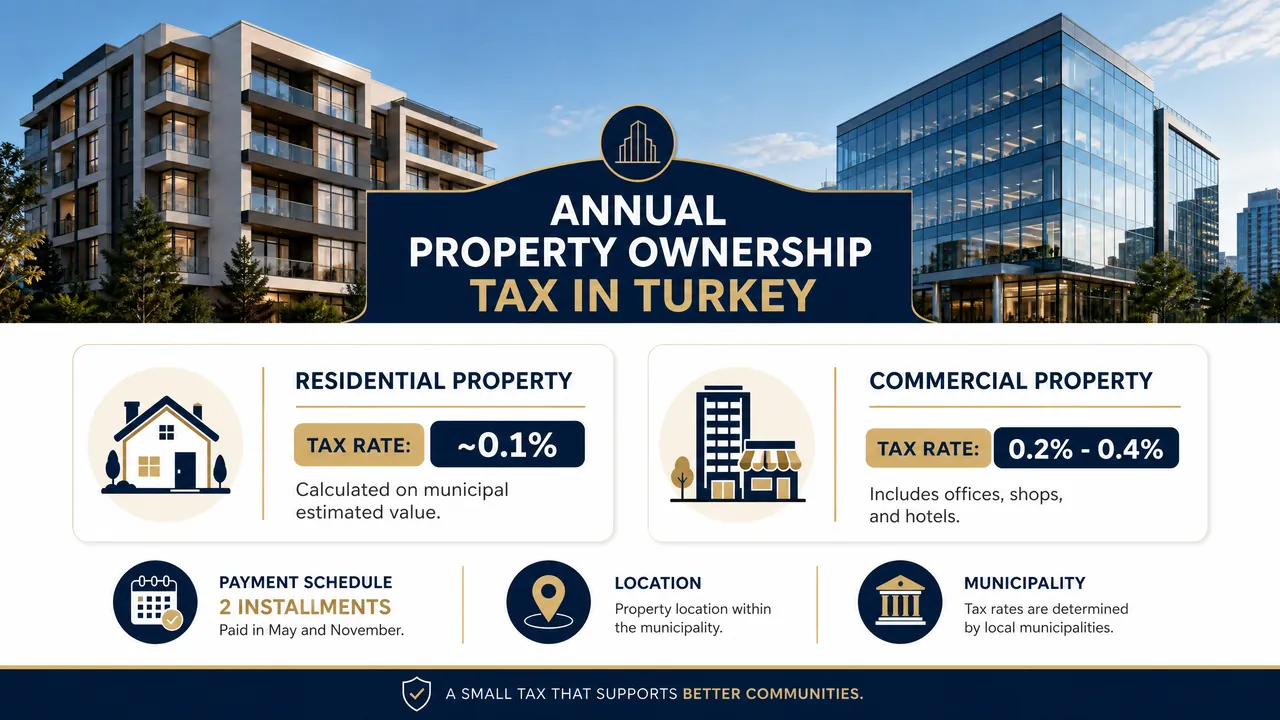
Property ownership tax in Turkey is considered one of the basic annual taxes borne by the property owner after acquisition, forming an important part of the costs of holding the property. This tax varies depending on the type of property and its location, whether residential or commercial, making it essential for every investor seeking to estimate annual costs accurately within their investment plan.
Residential Property Tax in Turkey
Residential property tax in Turkey is considered relatively low compared to many countries, usually starting from about 0.1% of the annual estimated value of the property, and may rise slightly in major cities like Istanbul and Ankara due to higher property values.
This tax is paid in two installments during the year, giving the owner flexibility in managing cash flow. This system contributes to alleviating the annual financial burden on investors and makes the Turkish real estate market more attractive and stable in the long term.
Commercial Property Tax in Turkey
Commercial property tax in Turkey is among the higher annual taxes compared to residential ones due to its income-generating capacity. The rates include:
- Offices: 0.2%–0.4% of the property value annually. For example, $200,000 equals approximately $400–$800 annually in major cities.
- Shops: 0.2%–0.4% of the annual property value, calculated according to the location of the commercial activity within major cities usually.
- Hotels: 0.2%–0.4% of the annual property value, and are often among the highest tax brackets in Turkey currently.
- Investment Properties: 0.2%–0.4% of the estimated value, including offices and large commercial complexes, varying approximately by municipality.
Cost of Real Estate Taxes in Turkey
The cost of real estate taxes in Turkey depends on a set of basic factors that determine the final value borne by the investor, varying from one property to another according to location and use:
- Property Location: Taxes differ between major cities like Istanbul and small towns due to differences in market values and municipal assessments.
- Type of Use: Residential properties are subject to lower rates compared to commercial and investment properties.
- Estimated Value: The tax is calculated based on the official value registered with the municipality, not the actual purchase price.
- Affiliated Municipality: Each municipality adopts different assessment rates within legal limits, affecting the total annual tax.
Generally, Turkey is considered one of the countries with relatively low real estate taxes compared to European countries. Check out the hidden costs when buying property in Turkey, and how to calculate real estate taxes, Tapu fees, and valuation accurately to avoid any unexpected financial surprises.
Sales Tax in Turkey and Real Estate Investment
Sales tax in Turkey is an important factor that foreign investors must consider when planning to sell property and realize profits, as this tax is linked to the period of ownership and capital gains. Understanding it accurately helps improve real estate investment decisions in Turkey and reduce unexpected costs within a successful investment strategy.
Sales Tax in Turkey
Sales tax in Turkey is imposed on profits resulting from the sale process when achieving capital gain, especially if the resale occurs within less than five years from the date of purchase. The tax is calculated on the difference between the purchase price and the selling price according to brackets that may range between 15% and 40% depending on income.
However, if the ownership period exceeds five full years, the investor is often exempt from real estate profit tax, making long-term investment more attractive and stable for foreign investors, according to the applicable Turkish tax law.
Real Estate Investment in Turkey and Taxes
Understanding real estate investment in Turkey and taxes is an essential element for determining actual profitability when entering the Turkish market, as all costs affecting investment return must be calculated:
- Includes purchase tax in Turkey at a rate of 4% of the registered property value, paid upon transfer of ownership.
- Annual Tax: Imposed on residential and commercial properties and varies according to the municipality, property type, and geographical location.
- Sales Tax: Imposed on capital gains when selling within less than five years usually.
- Real Estate Fees: Include translation, notarization, Tapu fees, and various administrative government services.
Real Estate Taxes in Turkey 2026
The latest updates indicate that real estate taxes in Turkey 2026 remain stable within a clear legal framework, with continued improvements in valuation, supervision, and acceleration of administrative procedures, enhancing the transparency of the real estate market for foreign investors:
- Property Valuation: Official property values are updated periodically, reflecting on annual taxes.
- Tax Supervision: Enhancing supervision on real estate transactions to limit manipulation and ensure tax compliance.
- Accelerating Procedures: Accelerating registration and ownership transfer procedures via digital platforms and reducing transaction duration.
- Tax Transparency: Unifying tax standards between citizens and foreigners to increase investment attraction.
Turkish Real Estate Tax Law and Exemptions
The Turkish Real Estate Tax Law and exemptions form the regulatory framework that defines the obligations and rights of investors when buying, owning, or selling properties, ensuring clarity of procedures and unification of tax standards. It also clarifies cases of tax exemptions aimed at supporting real estate investment and encouraging ownership, especially for foreigners within a stable and safe legal environment.
Turkish Real Estate Tax Law
The Turkish Real Estate Tax Law regulates all processes of imposing taxes on properties within the country, starting from the purchase and ownership stage until resale or leasing, defining the financial obligations for each investor clearly and uniformly without distinction between citizens and foreigners.
This law also establishes a precise framework for calculating taxes according to the type of property, its value, and location, providing a set of exemptions and incentives aimed at supporting real estate investment and enhancing the attractiveness of the Turkish market for foreign investors within a stable legal environment.
Tax Exemptions for Properties in Turkey
There are some tax exemptions for properties in Turkey in specific cases aimed at supporting investment and encouraging ownership, which are limited and not general:
- Major Investment Projects: Grant exemptions or reductions to attract capital.
- Development Zones: Taxes are reduced or exempted to stimulate local development.
- Profit Tax Exemption: When holding the property for a long period (such as 5 years).
These exemptions are linked to clear conditions within the Turkish Real Estate Tax Law and help reduce costs and improve the feasibility of real estate investment.
Importance of Understanding the Tax System
Deep understanding of the tax system in Turkey is an essential element for the success of any real estate investment, as it helps the investor analyze costs accurately and make more aware and stable financial decisions:
- Reducing Costs: By knowing the exemptions and discounts available in the tax system.
- Improving Return: By calculating all taxes within the investment feasibility study before buying or selling.
- Avoiding Financial Surprises: Such as additional fees or unexpected taxes during ownership or sale.
- Making Accurate Investment Decisions: Based on a comprehensive understanding of the Turkish Real Estate Tax Law and its application to different types of properties.
Comprehensive Table of Real Estate Taxes in Turkey
| Tax Type | Rate | Payment Time | Notes |
| Purchase Tax in Turkey | 4% of property value | One-time at purchase | Paid upon transfer of ownership, often split between parties, and considered the most important initial investment cost. |
| Property Ownership Tax | 0.1%–0.6% annually | Annually in two installments | Varies by city and property type, calculated on the municipal estimated value. |
| Sales Tax | 15%–40% on profits | At sale | Applied upon early sale before 5 years on capital gains. |
| Real Estate Fees in Turkey | Fixed fees | At registration | Includes Tapu, notarization, translation, and government services. |
| Rental Taxes | 15%–40% progressive | Annually | Imposed on rental income according to tax brackets. |
FAQs: Real Estate Taxes in Turkey for the Foreign Investor
It is a group of taxes that apply to purchasing, owning, renting, and selling real estate. These taxes apply equally to all property owners in Turkey, whether Turkish citizens or foreign nationals.
No. Foreigners pay the same tax rates as Turkish citizens without any additional charges or higher rates based on nationality.
They include a property purchase tax of approximately 4% of the property's value, in addition to annual property taxes ranging from about 0.1% to 0.6%, depending on the property's type and location.
Yes. Certain exemptions are available, such as for specific investment projects or exemption from capital gains tax after owning the property for more than five years in certain cases.
No. They are considered relatively stable under a transparent tax system, with periodic property valuation updates but no significant increase in the main tax rates.
Conclusion: Real Estate Taxes in Turkey for the Foreign Investor
In conclusion, understanding real estate taxes in Turkey for the foreign investor is an essential and indispensable step for anyone seeking to enter the Turkish real estate market with confidence and financial awareness.
Familiarity with the details of real estate tax in Turkey, property ownership tax in Turkey, and purchase tax in Turkey helps the investor build a clear vision of the true costs associated with owning, managing, and disposing of the property.
Including all fees and obligations within the investment plan contributes to making more accurate decisions and reduces potential financial risks.
On the other hand, understanding the Turkish Real Estate Tax Law and benefiting from tax exemptions for properties in Turkey opens the door to significantly improving investment returns, especially when planning for long-term investment.
With the stability of the tax system within the framework of real estate taxes in Turkey 2026, the Turkish market remains one of the most attractive markets for foreign investors thanks to its clarity, flexibility, and diversity of investment opportunities.