Investing in Small Warehouses in Turkey for Foreign Investors
Learn about small warehouse investment opportunities in Turkey for foreign investors, including location and size selection, purchase costs, rental demand, potential returns, and key risks to consider.
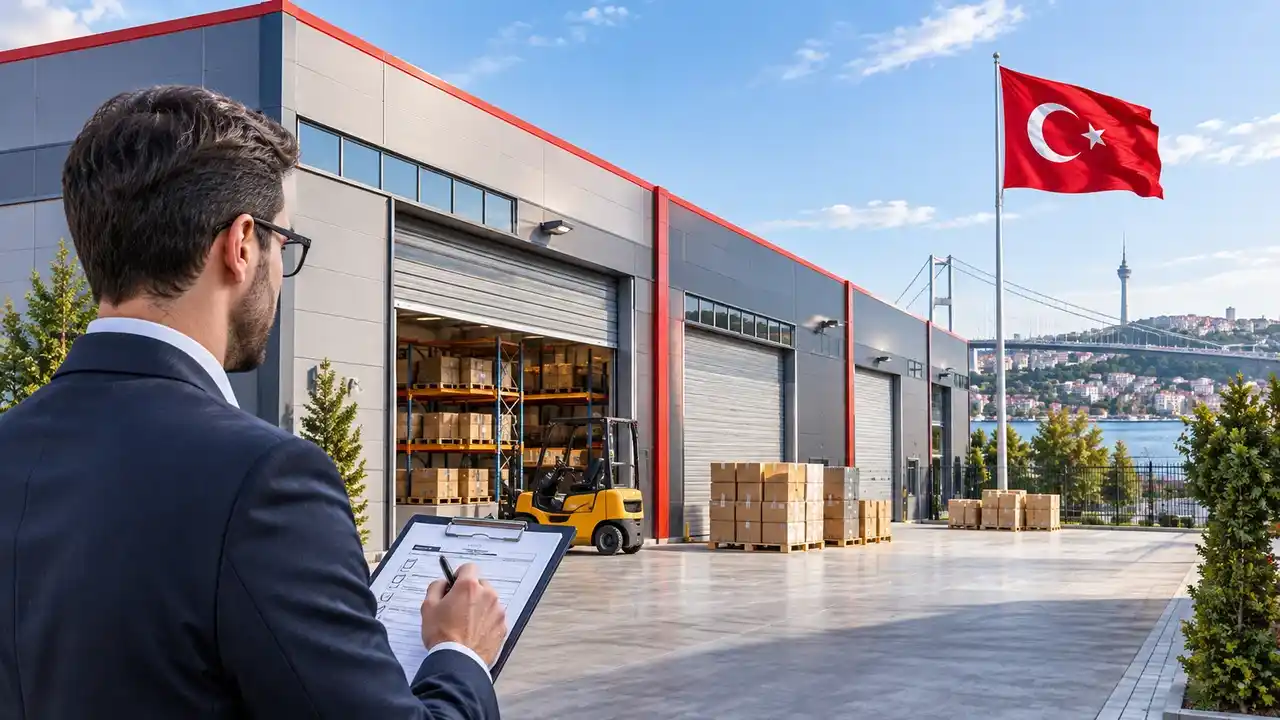
The commercial and logistics real estate sector in Turkey is attracting increasing interest from local and foreign investors, particularly with the expansion of e-commerce and the growing need for storage and distribution spaces near cities and commercial centers.
Investing in small warehouses in Turkey is one of the real estate options worth considering, given the potential to rent these spaces to small and medium-sized businesses, traders, distribution companies, and individuals.
Warehouse investment in Turkey offers an opportunity to diversify a real estate portfolio beyond traditional residential investments, whether by purchasing a warehouse in Istanbul or owning small storage units in industrial and commercial areas.
However, the success of this type of investment depends on choosing the right location, studying warehouse prices in Turkey, assessing demand for storage spaces, and calculating ownership and operating costs alongside expected rental returns.
Foreign investors need to understand the requirements for buying a warehouse in Turkey, as well as the procedures for registering ownership, taxes, and regulatory restrictions. This article explores how to invest in warehouses, the most promising areas, ways to generate profits, and the risks to consider before purchasing.
The Concept of Real Estate Investment in Turkey and the Importance of Investing in Small Warehouses
Real estate investment in Turkey offers a wide range of options, including residential, commercial, industrial, and logistics properties. Small warehouses stand out as real estate assets that serve storage, distribution, and commercial activities.
What Is Small Warehouse Investment in Turkey?
Small warehouse investment involves owning units designated for storage and renting them out to individuals and businesses, or using them for licensed commercial and logistics activities. These units vary in size, facilities, and intended use, and may include:
- Small warehouses for storing commercial goods and products.
- Individual storage units for furniture and personal belongings.
- Small warehouses serving online stores.
- Storage spaces for industrial materials and spare parts.
- Warehouses designated for small businesses and product distributors.
- Refrigerated storage units, where suitable infrastructure and permits are available.
Unlike large warehouses, this investment model relies on smaller units rented to a diverse range of tenants, allowing the investment to be distributed across several units.
Why Are Investors Turning to Commercial Real Estate Investment in Turkey?
Turkey's strategic location connecting Europe, Asia, and the Middle East, together with its ports, roads, and industrial zones, supports demand for commercial and logistics spaces. The main factors that make commercial real estate investment in Turkey worth considering include:
- Diversified income sources: The possibility of renting warehouses to different companies operating in trade, distribution, and industrial sectors.
- Logistics demand: Companies continue to need storage spaces close to markets and consumers.
- Rental flexibility: Some units can be rented under short-term or long-term contracts, depending on the nature of the activity and applicable laws.
- Investment portfolio diversification: Adding commercial assets alongside residential properties.
- Expansion opportunities: Starting with one small storage unit and purchasing additional units once the investment model proves successful.
The Role of E-Commerce in Increasing the Importance of Small Warehouses
The growth of e-commerce has changed companies' needs regarding product storage, inventory management, and order preparation. Some businesses now prefer smaller storage units close to residential and commercial areas to reduce delivery times and transportation costs.
These spaces benefit online retailers, local distribution companies, wholesale and retail traders, and startups that need to store their products without bearing the costs of renting large warehouses.
Discover our guide to buying commercial property in Istanbul for foreigners, and learn how to select suitable locations to achieve rental income and long-term investment returns while carefully assessing demand, costs, and risks.
Best Areas for Warehouse Investment and Buying a Small Warehouse in Istanbul
Location is essential to successful warehouse investment, and a property's value is closely linked to its proximity to industrial zones, roads, and ports. Suitable locations vary according to the tenant's needs: e-commerce warehouses require convenient access to customers, while industrial storage facilities benefit from being close to factories.
Buying a Warehouse in Istanbul and Important Logistics Areas
Istanbul is one of the most prominent markets worth considering for this type of investment because of the scale of its commercial, population, and logistics activities. The city includes various areas that may be suitable for investing in small storage units. The most notable areas worth studying include:
- Arnavutköy: Close to Istanbul Airport and major roads, making it suitable for logistics and distribution activities.
- Başakşehir: Home to commercial and industrial clusters, making it suitable for company warehouses and e-commerce businesses.
- Esenyurt: Characterized by a high population density and active commercial and industrial sectors, supporting demand for storage.
- Beylikdüzü: Close to Ambarlı Port and major roads, making it suitable for commercial storage and distribution.
- Tuzla: Includes industrial zones and manufacturing and logistics activities, making it suitable for warehouses serving industrial companies.
Investing in Warehouses Outside Istanbul
Warehouse investment is not limited to Istanbul. It also includes other industrial and commercial cities, where opportunities vary according to the characteristics of each location:
- Kocaeli: An important industrial and logistics center. Its warehouses benefit from proximity to Istanbul, ports, and industrial zones.
- Bursa: Home to diverse industrial and commercial activities, making it suitable for warehouses connected to manufacturing and spare parts.
- Izmir: A commercial and port city offering opportunities for warehouses associated with trade and distribution.
- Ankara: Has extensive industrial and commercial activity, making it suitable for warehouses serving companies and distributors.
Industrial activity does not automatically mean that a property is suitable for storage. Therefore, permitted use, licensing requirements, and market demand must be verified before purchasing.
Explore commercial and industrial real estate investment opportunities in Turkey, and learn about the types of real estate assets and areas worth considering based on your budget and intended business activity.
Warehouse Prices in Turkey and Returns on Small Warehouse Investments
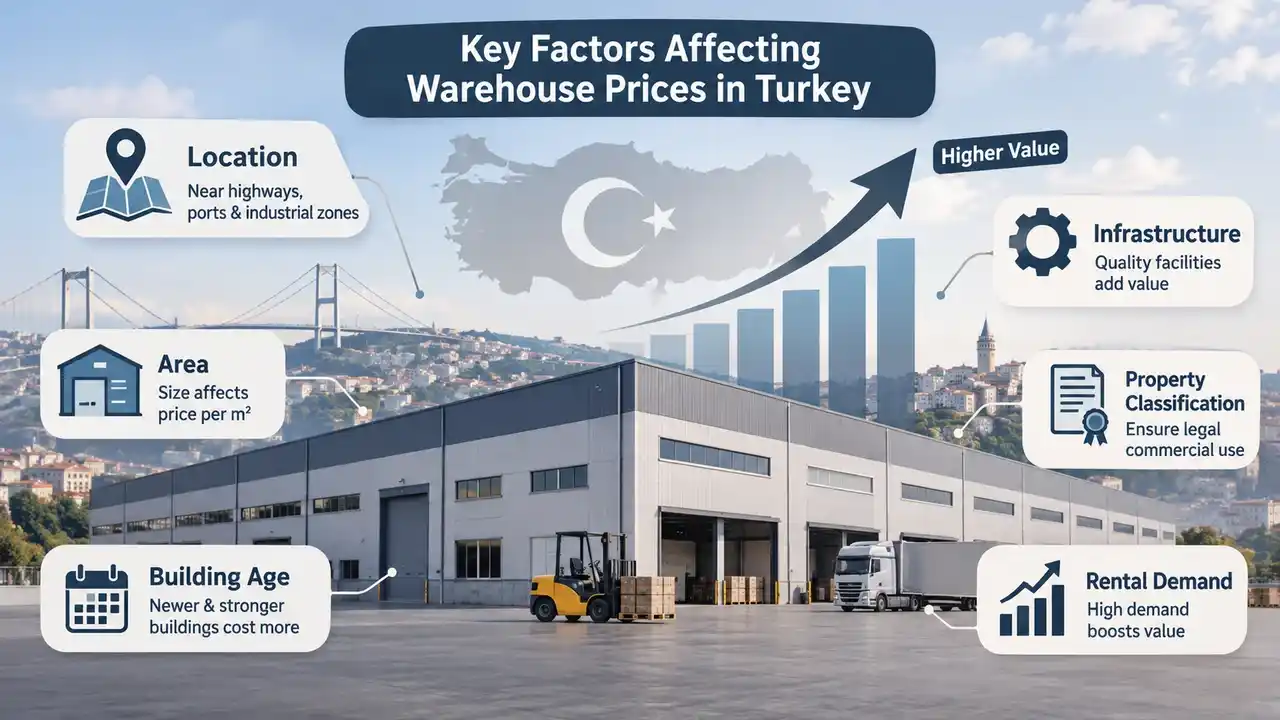
Warehouse prices in Turkey vary according to the city, location, area, building age, facilities, title deed type, and zoning classification. Therefore, there is no single standard price per square meter, and prices for large warehouses should not be used as a direct reference for small storage units.
What Factors Determine Warehouse Prices in Turkey?
Several factors influence the market value of warehouses, the most important of which are:
- Geographical location: Warehouses close to highways, ports, and industrial zones often offer greater operational advantages.
- Area: Small units differ in value from large warehouses, and the price per square meter is also affected by the property's total size.
- Infrastructure: The quality of flooring, ventilation, fire safety systems, electricity, and loading and unloading facilities affects the property's value.
- Property classification: It is essential to verify that commercial, industrial, or storage use is legally permitted.
- Building age: Structural condition, earthquake resistance, and required maintenance affect the price.
- Rental demand: Areas containing companies, factories, and stores that need storage may offer better rental opportunities.
Returns on Warehouse Investment in Turkey
Warehouse returns depend on the difference between rental income and the costs of owning and operating the property. A report covering the first half of 2026 indicated strong demand for modern warehouses in Turkey, alongside a limited supply of high-quality facilities.
The report indicated that investment yields for logistics and industrial facilities reached approximately 9%, while the investment payback period decreased to around 11 years. These indicators relate to the market in general and do not guarantee similar returns for small warehouses or individual storage units.
A report for the third quarter of 2025 showed that prime logistics warehouse rents in Istanbul reached USD 11.25 per square meter per month, with low vacancy rates in Istanbul and Kocaeli. These figures reflect the professional logistics market and do not directly apply to small warehouses.
How to Calculate Profits from Small Warehouse Investment in Turkey
The feasibility of a purchase can be assessed by calculating the gross rental yield. For example, purchasing a warehouse for USD 100,000 and renting it out for USD 800 per month generates annual rental income of USD 9,600.
The gross rental yield is 9.6% annually, calculated by dividing the annual rent by the purchase cost and multiplying the result by 100. However, this does not represent net profit after deducting taxes, maintenance, insurance, vacancy, management, and other expenses.
Renting Out Warehouses in Turkey and Ways to Generate Consistent Income
There are several models for investing in small warehouses. Choosing the most suitable one depends on the intended use and market conditions:
- Long-term rental: Renting the warehouse to a company or trader under a contract covering an agreed period.
- Short-term rental: Offering storage spaces under shorter contracts, provided that the permitted use and licensing allow it.
- Renting to e-commerce companies: Providing spaces for storing products and preparing orders.
- Commercial storage: Renting units to wholesalers, retailers, and distributors.
- Dividing storage spaces: Operating a larger warehouse as separate storage units, after verifying the applicable legal, technical, and safety requirements.
Choosing a stable tenant and establishing a clear rental contract can help reduce vacancy periods and the costs of finding replacement tenants.
Read how foreigners can invest wisely in Turkish real estate, and explore market opportunities, effective property selection strategies, ways to achieve stable returns, and how to check ownership and estimate expenses before purchasing.
Looking for a reliable real estate platform to sell your property quickly and transparently?
EmlakPlatform is not just an option, it is the smart solution for you. We combine advanced technology, full transparency, and professional support
Requirements for Foreigners Buying a Warehouse in Turkey and Legal Procedures
Turkish law allows eligible foreign nationals to own commercial properties, including warehouses, subject to applicable legal restrictions. An investor can purchase a warehouse in their own name without being required to establish a Turkish company.
Requirements for Foreigners Buying a Warehouse in Turkey
According to information published on the Turkish government's investment portal, several basic restrictions apply to property ownership by foreign individuals. The most notable include:
- A foreign individual may not own more than 30 hectares of property in Turkey.
- Foreign ownership may not exceed 10% of privately owned real estate within the relevant administrative area.
- Ownership is prohibited in restricted military and security zones.
- Some security-sensitive areas may require additional approvals. It is also necessary to verify whether the investor's nationality is eligible for property ownership.
These restrictions apply to foreign natural persons, while companies with foreign capital are subject to different provisions.
Steps for Foreign Investors to Buy a Warehouse in Turkey
Purchasing a warehouse in Turkey involves several essential legal and administrative steps, including:
- Selecting the right property: Choosing the location and area, comparing prices, and checking permitted uses.
- Checking the title deed (Tapu): Verifying the owner's identity and ensuring that the property is free from mortgages and legal restrictions.
- Verifying the license: Confirming that the property's use as a warehouse is legally permitted.
- Property valuation: Determining the market value through an accredited valuation company.
- Registering ownership: Officially transferring ownership at the competent Land Registry Office.
- Paying fees and taxes: Calculating registration fees, taxes, and additional costs.
The Turkish Investment Office confirms that ownership is transferred through official registration in the land registry, not merely by signing preliminary contracts.
Can a Foreigner Buy a Warehouse in Istanbul in Their Own Name?
Yes. A foreigner who is legally eligible can purchase a commercial warehouse or storage facility in Istanbul in their own name, provided that ownership requirements are met and there are no restrictions affecting the property or its location.
However, if the purchase is made through a Turkish company in which the foreign investor owns 50% or more of the shares, or has the right to appoint and dismiss the majority of the board of directors, special provisions applicable to companies with foreign capital will apply.
The transaction may require reviewing the relevant administrative authorities, depending on the property's location and the nature of the area. This situation differs from a foreign individual purchasing property in their personal capacity. Therefore, it is important to determine the ownership structure before beginning the purchase procedures.
Taxes and Fees Associated with Buying and Operating Warehouses
The following costs should be included in the investment budget:
- Real estate title deed transfer tax (Tapu Harcı).
- Land registry service and registration fees.
- Value Added Tax (VAT), where applicable to the transaction.
- Annual property tax.
- Income tax on rental income, according to the applicable tax system.
- Maintenance, insurance, and management costs.
- Real estate brokerage commission, if an intermediary is involved.
The title deed transfer tax is 4% of the property's value, with 2% payable by each party, based on the declared sale value.
Learn more through this guide to understanding real estate taxes and fees in Turkey for foreigners, and calculate the actual costs before purchasing, renting out, or selling a property to understand your financial obligations and plan your real estate investment.
How Foreign Investors Can Invest in Warehouses in Turkey and the Potential Risks
Successful investment in small warehouses requires a clear plan that begins with market research and continues through property management and income monitoring. Buying a property at a low price alone is not enough to generate good profits. The property must also be suitable for its intended use and rentable according to market needs.
How Foreign Investors Can Invest in Warehouses in Turkey
The investment strategy can be divided into five main stages:
- Identifying target tenants: Such as e-commerce companies, distributors, traders, and individuals looking for storage spaces.
- Studying local demand: Analyzing commercial and industrial activity, rental prices, competition, and occupancy rates.
- Choosing the appropriate space: Starting with a small unit or purchasing several units to distribute investment risks.
- Negotiating the purchase price: Comparing prices, assessing the property's condition, and estimating the costs of preparing it for operation.
- Preparing a rental and operating plan: Setting rental rates, contracts, maintenance costs, and a system for managing tenants.
The Main Risks of Investing in Small Warehouses in Turkey
Despite the available opportunities, several risks should be carefully considered before making a purchase:
- Vacancy risks: There may be periods when no suitable tenant can be found, affecting cash flow.
- Location risks: The property may be far from roads and commercial areas, reducing demand.
- Legal risks: Purchasing a property whose zoning classification does not permit warehouse use.
- Exchange rate fluctuations: The investment's value may be affected when income and expenses are calculated in different currencies.
- Maintenance costs: Some warehouses may require additional facilities or structural repairs.
- Safety risks: The absence of appropriate fire safety systems, ventilation, and exits for the intended storage activity.
- Competition: New warehouses entering the market or declining rental prices in the area.
How Can a Foreign Investor Choose the Right Warehouse?
Before completing the purchase, it is advisable to review several essential criteria:
- Confirm that the title deed is valid and the property's legal status is clear.
- Review the building permit and the permitted use.
- Check the building's earthquake resistance and structural condition.
- Assess how easily trucks and delivery vehicles can access the property.
- Compare actual rental rates in the area.
- Calculate the net return after taxes and expenses.
- Verify that genuine demand exists for storage spaces.
- Review the rental, operating, and insurance requirements.
Discover the steps for foreigners to buy property in Turkey, from legal checks to title deed registration, to ensure secure ownership, avoid risks and procedural mistakes, and make an informed decision that protects your investment rights.
Comparison Table of Small Warehouse Investment Models in Turkey
| Investment Model | Target Customers | Main Advantages | Challenges |
| Individual storage units | Individuals and families | Diverse tenant base | Managing a large number of customers |
| E-commerce warehouses | Online stores | Demand linked to distribution | Need for convenient access |
| Small commercial warehouses | Traders and distributors | Diverse commercial activities | Price competition |
| Small industrial warehouses | Companies and factories | Potential for long-term contracts | Technical and regulatory requirements |
| Refrigerated warehouses | Food and distribution companies | Specialized service | High operating costs |
Frequently Asked Questions About Investing in Small Warehouses in Turkey
Yes, a foreign investor who is legally eligible can purchase a commercial warehouse or storage facility in Turkey in their personal name, without being generally required to establish a Turkish company. The applicable ownership restrictions regarding property size, security zones, and nationality eligibility must be observed.
Investing in small warehouses can be profitable when the right location is selected, the property is purchased at a competitive price, and it is rented to clients with ongoing storage needs. Profitability depends on the purchase price, rental income, occupancy rates, operating costs, and taxes.
Arnavutköy, Başakşehir, Esenyurt, Beylikdüzü, and Tuzla are worth considering due to the differences in their commercial, industrial, and logistics activities. The final choice depends on the type of tenant being targeted, property prices, and the property's legal classification.
The gross rental yield can be calculated by dividing the annual rental income by the total property purchase cost and then multiplying the result by 100. To calculate the net yield, taxes, maintenance, insurance, management expenses, and periods of vacancy must be deducted.
The requirements include eligibility based on nationality, compliance with the permitted property ownership limits, ensuring that the property is not located in a prohibited military zone, verifying the title deed and any property restrictions, and completing the official registration procedures at the Land Registry Office.
Conclusion: Investing in Small Warehouses in Turkey for Foreign Investors
Investing in small warehouses in Turkey offers a real estate opportunity worth considering for foreign investors, particularly given the importance of the logistics and commercial sectors and the growing need among companies for storage and distribution spaces.
Investors can benefit from the diversity of the Turkish real estate market by purchasing a warehouse in Turkey, buying a warehouse in Istanbul, or investing in small storage units designed for individuals and businesses.
However, generating profits from small warehouse investments in Turkey requires studying warehouse prices, analyzing investment returns, selecting suitable areas, and verifying the requirements and legal permits for foreigners buying a warehouse in Turkey.
With sound financial planning, effective management, and the selection of suitable tenants, investors can build a long-term commercial investment based on rental income while achieving greater diversification in their real estate portfolios.