Restrictions on Areas Eligible for Turkish Citizenship Through Real Estate
Learn about geographic restrictions on real estate eligible for Turkish citizenship, the difference between neighborhoods open and closed to foreign ownership, and how to verify a property's location before purchasing.
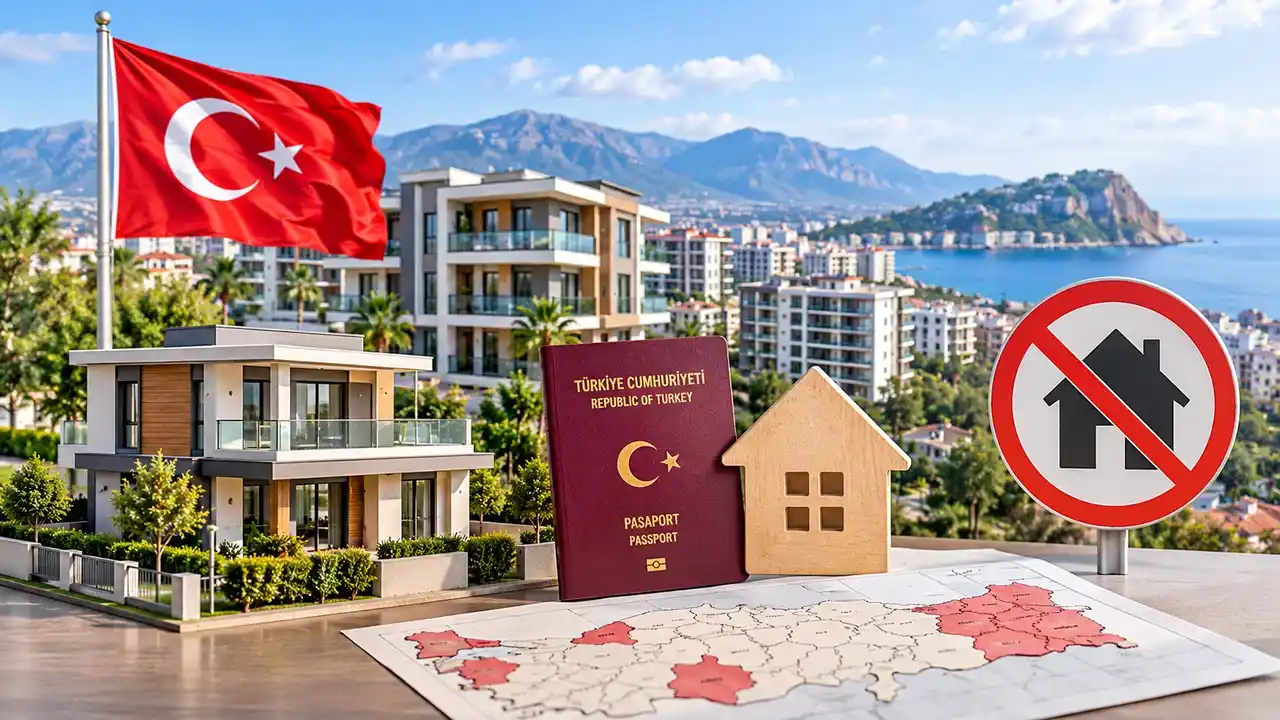
Understanding the restrictions on real estate areas eligible for Turkish citizenship is one of the most important steps foreign investors should consider before purchasing property in Turkey with the aim of obtaining Turkish citizenship through real estate investment.
Although foreign nationals are permitted to own property in most parts of Turkey, legal, security, and regulatory rules determine where property purchases are allowed. These include limits on the proportion of property that foreigners may own in certain areas, as well as restrictions relating to military and security zones.
It is particularly important to distinguish between areas where foreign ownership is prohibited and neighbourhoods closed to foreign nationals for address registration or residence procedures. The closure of a neighbourhood to residence transactions does not mean that property purchases are prohibited there or that the area is excluded from the Turkish citizenship programme. Investors should therefore verify the legal status and location of a property before purchasing it.
This article examines in detail the real estate areas eligible for Turkish citizenship, neighbourhoods closed to foreign ownership in Turkey, prohibited military zones, and restrictions imposed on foreign property ownership.
It also explains the conditions for purchasing property to obtain Turkish citizenship, the procedures for verifying a property's eligibility for real estate investment and citizenship, and the main legal steps that help investors make a safe and well-informed decision.
Real Estate Areas Eligible for Turkish Citizenship and Legal Ownership Rules
Turkish law allows foreign nationals of eligible nationalities to purchase property in various cities and areas where private ownership is legally permitted. This includes residential and commercial properties, as well as land, subject to the applicable legal and regulatory restrictions.
However, it is important to distinguish between a foreign national's right to purchase a property and the property's eligibility for meeting the requirements for Turkish citizenship. Not every property that can be purchased in Turkey automatically qualifies for citizenship through investment.
What Are Real Estate Areas Eligible for Turkish Citizenship?
Real estate areas eligible for Turkish citizenship are locations where foreign nationals are legally permitted to own property and where no restrictions prevent the purchase or make it impossible to fulfil the requirements for a qualifying real estate investment. The eligibility of an area is determined by several factors, most notably:
• The property must not be located in a prohibited military zone or a security area where foreign ownership is banned.
• The legal limits on foreign property ownership in the area must not have been exceeded.
• The property must be eligible for official registration with the Land Registry and Cadastre Directorate (Tapu).
• The property must meet the real estate investment requirements for obtaining Turkish citizenship.
• There must be no legal restrictions or rights in rem that prevent the transfer of ownership or affect the registration process.
The Difference Between Purchasing Property and Obtaining Turkish Citizenship
A property may be available for purchase by foreign nationals but may not meet the requirements for a qualifying real estate investment for Turkish citizenship. For example, its value may be below the required financial threshold, or there may be an issue with its valuation, ownership registration, or applicable legal restrictions. Investors should therefore verify two separate matters:
Ownership eligibility: Confirm that the buyer's nationality allows them to purchase the property and that its location is not subject to a legal prohibition.
Citizenship eligibility: Confirm that the property, its value, and the method of purchase meet the requirements for obtaining Turkish citizenship.
Cities and Areas Open to Property Purchases in Turkey
Areas open to property purchases are found across Turkey's major cities, tourist destinations, and investment locations. There is no single geographical list that makes an entire city automatically eligible or ineligible for citizenship. Some of the main cities with active real estate markets include:
• Istanbul: Offers a wide range of residential and commercial districts and various real estate investment opportunities.
• Ankara: Features residential and commercial developments in different parts of the capital.
• Antalya: One of Turkey's leading tourist real estate destinations.
• Bursa: Offers investment opportunities in residential, industrial, and commercial areas.
• Izmir: Known for its diverse real estate developments and its economic and tourism significance.
• Trabzon: Includes residential projects that attract foreign investors.
These cities are not entirely eligible or excluded. Each property must be assessed individually in terms of its legal location and investment requirements before purchase.
To learn about the laws and restrictions investors should understand before purchasing property, explore the guide Property Ownership in Turkey: Laws, Rights, and Benefits for Foreigners, which explains ownership requirements, prohibited areas, and foreign ownership limits.
Areas Where Foreign Property Ownership Is Prohibited in Turkey and Closed Neighbourhoods
Turkey imposes restrictions on foreign property ownership in certain locations for reasons relating to national security, the protection of strategic facilities, and the regulation of property ownership. Prohibited ownership areas should not be confused with neighbourhoods closed to residence transactions, as each category has a separate legal basis and different consequences.
Prohibited Military Zones in Turkey
Prohibited military zones are governed by Law No. 2565 on Military Forbidden Zones and Security Zones. Under this law, foreign nationals are prohibited from owning property within prohibited military zones and military security zones in order to protect national security and military facilities.
These restrictions cover areas surrounding sensitive military installations and strategic locations, according to boundaries determined by the competent authorities. The mere proximity of a property to a military facility is not sufficient to establish that ownership is prohibited. The property's official classification and the legally defined boundaries of the restricted area must be checked.
Security Zones Where Property Ownership Is Restricted in Turkey
Security zones differ from prohibited military zones in terms of their classification and legal procedures. Certain locations may be subject to special security restrictions because of strategic facilities, essential infrastructure, or public security considerations.
In some special security areas, legislation may allow property ownership after obtaining approval from the competent authorities, such as the Governor's Office (Valilik). In other areas, ownership is prohibited according to the applicable legal classification.
Therefore, it is not enough to confirm that a property is outside a prohibited military zone. Investors must also check whether it falls within a security classification that requires additional approval from the relevant authorities.
Neighbourhoods Closed to Foreign Property Ownership in Turkey
The term "neighbourhoods closed to foreign property ownership in Turkey" is commonly used, but it can be legally misleading when discussing property purchase requirements and restrictions.
The closure announced by the Turkish Directorate General of Migration Management primarily concerns restrictions on certain address registration and residence procedures for foreign nationals in neighbourhoods with high proportions of foreign residents. It does not necessarily mean that foreigners are prohibited from purchasing property or registering ownership there.
Neighbourhoods Closed to Foreign Address Registration and Residence Restrictions in Turkey
On 1 July 2022, the Turkish Directorate General of Migration Management announced that the number of neighbourhoods closed to certain foreigner registration procedures had increased to 1,169, compared with 781 previously. The restrictions covered procedures such as:
• Registering certain newly arriving foreign nationals in the neighbourhood.
• Applications for certain types of residence permits.
• Changing a residence address to a neighbourhood covered by the restrictions.
• Certain international protection and temporary protection procedures, subject to legal exceptions.
Accordingly, these neighbourhoods should not automatically be classified as areas where foreign property purchases are prohibited, because residence and address registration restrictions are different from property ownership restrictions.
Before choosing a property in Istanbul, learn how geographical restrictions may affect property purchases and residence registration through the article Restricted Areas in Istanbul: Address Registration and Foreign Property Ownership.
Restrictions on Foreign Property Ownership in Turkey and Permitted Ownership Limits
Property restrictions in Turkey are not limited to military and security zones. They also include limits on the total area of property that a foreign national may own and the proportion of property owned by foreigners within administrative areas. These rules aim to regulate ownership and balance investment opportunities with national interests.
Foreign Ownership Limits in Turkish Real Estate Areas
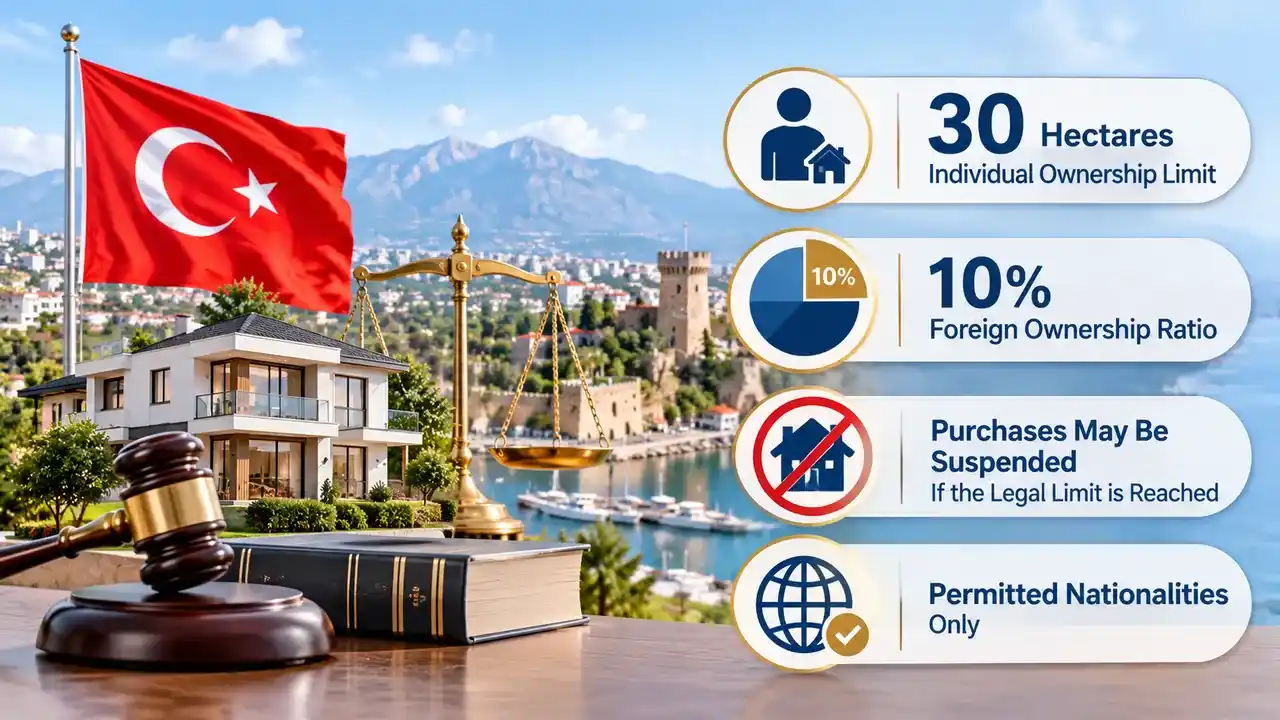
Under Article 35 of Land Registry Law No. 2644, foreign property ownership is subject to limits concerning the total area of real estate owned by foreign nationals within administrative areas. The main legal restrictions include:
• Individual ownership limit: A foreign national may not own more than 30 hectares of property in Turkey unless approval is obtained from the competent authorities.
• Foreign ownership ratio: The total area of property owned by foreign nationals must not exceed 10% of the area of the relevant administrative area where ownership is permitted.
• Reaching the legal limit: New purchases may be suspended once the permitted ratio has been reached.
• Nationality restrictions: Buyers must hold a nationality that is permitted to own property in Turkey.
It should be noted that the 10% limit relates to the area of property owned by foreign nationals under the applicable legal rules. It does not determine the number of apartments or the proportion of foreign ownership in a particular real estate project.
Looking for a reliable real estate platform to sell your property quickly and transparently?
EmlakPlatform is not just an option, it is the smart solution for you. We combine advanced technology, full transparency, and professional support
Conditions for Foreigners Purchasing Property in Turkey
Foreign property purchases are subject to several conditions that should be checked before signing a sales agreement or paying for the property. The main conditions include:
- The buyer must be a national of a country whose citizens are permitted to own property under Turkish law.
- The property must not be located in a prohibited military zone or another area where ownership is banned.
- The maximum permitted area of property ownership must be respected.
- The legally prescribed foreign ownership ratio in the relevant administrative area must not be exceeded.
- The transfer of ownership must be officially registered with the Land Registry and Cadastre Directorate.
- The property must be checked for mortgages, attachments, or legal restrictions that could prevent the transfer of ownership.
Certain nationalities are subject to specific restrictions. Syrian nationals, for example, cannot purchase property in Turkey under Law No. 1062 concerning reciprocity, and cannot apply for Turkish citizenship through property purchase, according to the clarification issued by the General Directorate of Population and Citizenship Affairs.
Do Ownership Restrictions Differ Between Turkish Cities?
Foreign ownership restrictions are not determined by the city name alone. They vary according to the administrative area and the property's specific location. For example, property purchases may be permitted in one district of Istanbul, while another property in the same district or a different area may be subject to security or regulatory restrictions.
The possibility of purchasing property may also change if the legal limit on foreign ownership is reached or new regulatory decisions are issued. For this reason, every property should be checked individually rather than relying on general information about a city or residential district.
Find out whether property can be purchased in a neighbourhood closed to foreign address registration by exploring the legal details and available opportunities in the guide Closed Areas in Istanbul: Understanding Property Ownership Requirements.
Requirements for Purchasing Property to Obtain Turkish Citizenship and Verifying Eligibility
Real estate investment is one of the legal routes to obtaining Turkish citizenship, but it requires compliance with financial, legal, and procedural conditions. It is not enough for a property to be located in an area open to purchases. The property must also meet the requirements of the citizenship programme in force when the application is submitted.
Minimum Property Value for Obtaining Turkish Citizenship
According to the official requirements in force as of November 2026, a foreign investor must purchase one or more properties with a total value of at least USD 400,000, or its equivalent in foreign currency or Turkish lira, in accordance with the approved valuation and registration procedures. The following conditions must also be met:
• The property must be officially registered in the investor's name with the Land Registry.
• The minimum investment value must be met according to the official valuation and procedures.
• An undertaking not to sell the property for three years must be registered.
• Compliance with the investment requirements must be demonstrated by obtaining a Certificate of Conformity (Uygunluk Belgesi).
• The residence procedures associated with the citizenship application and the relevant official procedures must be completed with the competent authorities.
Procedural details may vary depending on the type of property, the method of purchase, and the date on which the transaction is registered.
How to Verify a Property's Eligibility for Turkish Citizenship
Verifying a property's eligibility for Turkish citizenship is one of the most important steps in protecting investors from legal and financial risks. Several checks should be completed before finalising the purchase, including:
Check the geographical location: Confirm that the property is not subject to military or security restrictions.
Review the land registry: Verify the ownership records and whether the property can legally be transferred.
Check the property valuation: Confirm that the property meets the minimum value required for citizenship.
Verify investor eligibility: Check whether the investor's nationality permits property ownership in Turkey.
Review the investment conditions: Ensure that the registration requirements and the three-year no-sale undertaking can be fulfilled.
How to Identify Areas Where Foreigners Are Allowed to Own Property in Turkey
Investors can consult official authorities to verify a property's legal status before making any payment. The main verification channels include:
• Land Registry and Cadastre Directorate (TKGM): To check ownership eligibility and property restrictions.
• Local Land Registry Office: To review the property's records and ownership transfer procedures.
• Governor's Office (Valilik): To verify security restrictions and any required approvals.
• Directorate General of Migration Management: To enquire about closed neighbourhoods and residence restrictions.
• General Directorate of Population and Citizenship Affairs: To verify the requirements and procedures for Turkish citizenship.
Investors can also use the Parcel Query system (Parsel Sorgu), operated by the General Directorate of Land Registry and Cadastre, to check information about the location and cadastral parcel. However, the appearance of a property's details in the system does not, by itself, constitute approval of its eligibility for Turkish citizenship.
Learn more about the legal rules, military and security zones, and exceptions relating to foreign ownership in the article Legal Conditions for Foreigners Purchasing Real Estate in Turkey.
Areas Closed to Turkish Citizenship Through Real Estate Investment and Key Risks
A common mistake is to assume that every property advertised for sale in Turkey is suitable for obtaining Turkish citizenship, or that every neighbourhood closed to foreign nationals is excluded from the real estate investment programme.
In fact, areas that are ineligible for Turkish citizenship through real estate investment cannot be identified simply by referring to lists of neighbourhoods closed to residence transactions. Investors must instead rely on the legal restrictions governing property ownership and qualifying real estate investments.
Do Neighbourhoods Closed to Residence Prevent Obtaining Turkish Citizenship?
There is no general legal rule under which closing a neighbourhood to foreign address registration automatically prevents property purchases or excludes the area from the Turkish citizenship programme. A foreign national may be able to purchase a property and register it in their name in a neighbourhood closed to certain residence procedures, provided that no other restrictions prohibit ownership.
However, investors must distinguish between purchasing property for investment and obtaining citizenship, on the one hand, and purchasing property to obtain a real estate residence permit, on the other. Each route has its own requirements and procedures. Therefore, lists of closed neighbourhoods should not be the sole basis for selecting a property for citizenship purposes.
Key Risks to Avoid When Purchasing Property for Turkish Citizenship
Investors may face legal or financial problems if they fail to verify a property's eligibility before completing the transaction. The main risks include:
• Purchasing a property located in a military or security zone where foreign ownership is prohibited.
• Relying on the advertised sale price without checking the officially accepted property valuation.
• Purchasing a property that does not meet the required minimum investment value.
• Overlooking a mortgage, attachment, or legal right that may affect the transfer of ownership.
• Relying on unofficial lists of prohibited areas or closed neighbourhoods.
• Paying for the property before confirming that it can be registered and meets the citizenship requirements.
• Assuming that registering the property in the investor's name automatically guarantees approval of the citizenship application.
How to Choose a Property Suitable for Obtaining Turkish Citizenship
The selection process should be based on a comprehensive legal and investment assessment, rather than geographical location or price alone. Investors are advised to follow these steps:
Identify the city and area where the investor intends to purchase property.
Select a property and verify its official land registry details.
Confirm that no military or security restrictions prohibit ownership.
Review the legal limits on foreign property ownership.
Obtain a property valuation and confirm that it meets the required financial threshold.
Confirm that the property can be registered and that the three-year no-sale undertaking can be recorded.
Complete the Certificate of Conformity procedures and submit the citizenship application in accordance with the official requirements.
Following this sequence helps reduce the risks associated with real estate investment and gives investors a clearer picture before making a purchase decision.
To ensure that the purchase is completed in accordance with Turkish law and to avoid legal obstacles, read the guide Steps to Buy Property in Turkey for Foreigners before making your decision and completing the ownership transfer.
Overview of Real Estate Areas and Restrictions Affecting Foreign Ownership and Turkish Citizenship
| Type of area or restriction | Foreign ownership eligibility | Effect on citizenship |
| Areas open to property ownership | Permitted subject to the applicable conditions | Possible if all requirements are met |
| Prohibited military zones | Prohibited | Not eligible |
| Prohibited military security zones | Prohibited | Not eligible |
| Special security areas | Approval may be required, depending on the case | Depends on approvals and eligibility |
| Neighbourhoods closed to residence procedures | Closure does not necessarily prohibit ownership | Not automatically excluded |
| Areas that have reached the foreign ownership limit | New purchases may be suspended under the applicable restriction | Requirements cannot be met if ownership is not permitted |
| Properties subject to legal restrictions | Depends on the nature of the restriction | Depends on whether registration and the requirements can be fulfilled |
Frequently Asked Questions About Real Estate Areas Eligible for Turkish Citizenship
No, not all areas are automatically eligible. Certain military and security zones prohibit foreign nationals from owning property, in addition to legal restrictions concerning property ownership limits and the percentage of foreign ownership. Therefore, the specific location of the property must be checked before making a purchase.
Yes, purchasing property may be possible in neighborhoods that are closed to certain residence permit applications and address registrations, as these restrictions do not necessarily mean that property ownership is prohibited. However, it is essential to verify that there is no separate restriction on the specific property itself.
The minimum real estate investment qualifying for Turkish citizenship is USD 400,000 or its equivalent. The investor must undertake not to sell the property for three years and meet all other legal and procedural requirements.
You can consult the Land Registry and Cadastre Directorate, check for military and security restrictions, obtain a property valuation, and confirm the investor's eligibility as well as the property's compliance with the minimum investment value and other investment requirements. The Certificate of Conformity procedures can then be completed.
According to the Turkish General Directorate of Population and Citizenship Affairs, Syrian citizens cannot obtain Turkish citizenship through property purchase due to the restrictions associated with Reciprocity Law No. 1062, which prohibits Syrian nationals from owning real estate in Turkey.
Conclusion: Restrictions on Real Estate Areas Eligible for Turkish Citizenship
Understanding the restrictions on real estate areas eligible for Turkish citizenship is an essential step for every foreign investor seeking Turkish citizenship through real estate investment.
Choosing a suitable property depends not only on its price, location, or expected investment return, but also on verifying the laws governing foreign ownership, prohibited military and security zones, foreign ownership limits, and the legal requirements for property registration.
It is essential to distinguish between areas where foreign property ownership is prohibited in Turkey and neighbourhoods closed to residence transactions, because each category is governed by different legal rules and has separate regulatory consequences.
Verifying a property's eligibility, consulting the official authorities, meeting the USD 400,000 investment requirement, and retaining the property for three years are necessary steps to protect a real estate investment in Turkey.