The Future of Real Estate Investment in Turkey Amid Changing Interest Rates and Inflation
Learn about the future of real estate investment in Turkey amid changing interest rates and inflation, and how economic shifts affect property values, demand, and investment opportunities.

Real estate investment in Turkey is going through an important phase as changes in interest rates and inflation continue, alongside shifts in the behavior of buyers and investors. The year 2026 comes at a time when the Turkish economy is seeking to achieve greater price stability, while the real estate sector remains one of the most prominent areas for investment and asset preservation.
According to data from the Turkish Statistical Institute, total residential property sales reached 127,410 units in August 2026, while total sales between January and August reached 950,529 units.
At the same time, annual inflation in Turkey stood at 31.51% in August 2026, while the Central Bank of the Republic of Turkey kept its policy rate at 37% in September. This makes the relationship between inflation, interest rates, and property prices a key factor when studying the future of real estate in Turkey.
This article discusses real estate investment in Turkey in 2026, the development of property prices in Turkey in 2026, trends in the Turkish real estate market in 2026, the impact of monetary policy and inflation on investors’ decisions, as well as forecasts for property prices in Turkey and the factors that may affect the return on real estate investment in Turkey during the coming period.
Real Estate Investment in Turkey 2026 Between Inflation and Interest Rates
Real estate investment in Turkey in 2026 is experiencing important changes as inflation and high interest rates continue. These factors affect financing costs, demand, and property prices, while prime locations remain a key factor in determining value. Therefore, investment requires studying prices, rents, financing costs, and expected returns, while continuously monitoring economic and market developments.
The Impact of Inflation on Real Estate in Turkey
The impact of inflation on real estate in Turkey is one of the most important elements that should be analyzed when evaluating the market. Rising construction, material, labor, and service costs can affect project development costs and the prices of new units.
In August 2026, the annual Consumer Price Index increased by 31.51%, while the housing, water, electricity, gas, and fuel group increased by 39.77% year on year.
However, rising nominal property prices do not necessarily mean a real increase in value. August data showed that housing prices in Turkey continued to decline in real terms for the ninth consecutive month, highlighting the importance of distinguishing between an increase in prices in Turkish lira and a change in value after accounting for inflation.
The Impact of Interest Rates on Real Estate in Turkey
The impact of interest rates on real estate in Turkey is particularly evident in financing costs and demand for credit-financed housing. When borrowing costs are high, some buyers may have less ability to obtain mortgage financing.
Nevertheless, the latest data from the Turkish Statistical Institute (TÜİK) indicate that mortgaged home sales increased by 7.2% year on year in August 2026, reaching 22,131 units. They also increased by 27.6% during January–August to 188,813 units.
Interest Rates and Real Estate in Turkey
On September 10, 2026, the Central Bank of the Republic of Turkey kept its one-week repo rate at 37%, with the overnight lending rate at 40% and the borrowing rate at 35.5%. The bank confirmed that it would maintain a tight monetary policy stance until price stability is achieved. Therefore, interest rates and real estate in Turkey will remain closely linked to the path of inflation, monetary decisions, and financing costs during the coming period.
Discover the Turkish real estate market analysis in 2026, and learn about price trends, the most important investment opportunities, and the risks that should be studied before making your real estate decision in the Turkish real estate market.
The Future of Real Estate in Turkey and Market Developments During 2026
The future of real estate in Turkey during 2026 is influenced by developments in inflation, interest rates, domestic and foreign demand. The market continues to record active transactions despite differences in performance between cities and areas. Construction costs, rents, and financing also affect investors’ decisions. Therefore, evaluating the Turkish real estate market in 2026 requires analyzing location, prices, liquidity, and expected returns before purchasing.
The Turkish Real Estate Market in 2026
Sales data reflect continued market activity despite a decline in total sales compared with the previous year. Total residential property sales reached 950,529 units during the first eight months of 2026, down 6.8% compared with the same period in 2025.
In contrast, mortgage-financed sales increased by 27.6% during the same period, a development worth monitoring when analyzing the Turkish real estate market in 2026.
The data also indicate that existing homes continue to account for the largest share of total sales, with 83,032 units recorded in August compared with 44,378 new homes.
The Future of the Turkish Real Estate Market
The future of the Turkish real estate market depends on an interconnected set of factors, most notably the inflation path, interest rates, the Turkish lira exchange rate, construction costs, rental growth, domestic demand, foreign demand, and developments in credit conditions.
It is important not to view Turkey as a single real estate market, as differences between Istanbul, Ankara, Antalya, Izmir, and other cities can be significant in terms of prices, demand, rents, and liquidity.
Real Estate Investment in Istanbul 2026
Real estate investment in Istanbul in 2026 represents a special case due to the city’s vast size and diversity of districts, the development of its infrastructure, continued domestic and foreign demand, and variations in prices and investment returns between areas and real estate projects.
However, evaluating a property in Istanbul requires studying the district, the project, proximity to transportation and services, rental levels, purchase price, and expected liquidity rather than relying solely on citywide averages.
Learn about the impact of inflation on the real estate market in Turkey, and understand how economic variables can affect investment opportunities and property values in Turkey during the coming period.
Property Prices in Turkey 2026 and Market Forecasts
Property prices in Turkey in 2026 are affected by inflation, interest rates, construction costs, and domestic and foreign demand. Price levels vary between cities and areas according to location, services, and infrastructure. Property price forecasts in Turkey remain linked to the path of the economy and financing conditions. Therefore, it is advisable to compare prices, rents, and expected returns before making a real estate investment decision.
Property Prices in Turkey 2026
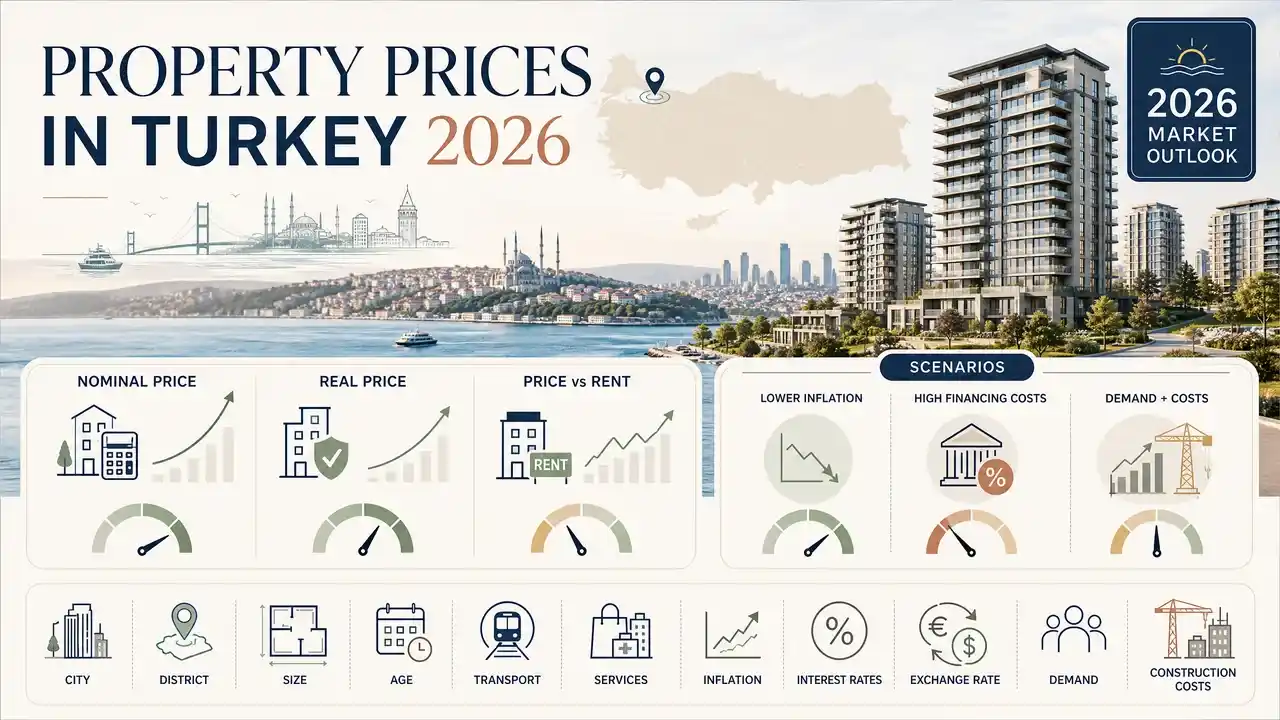
When analyzing property prices in Turkey in 2026, three main indicators should be distinguished: nominal price, real price after accounting for inflation, and the property price relative to rental levels.
This distinction is important because an increase in prices in Turkish lira does not necessarily mean an increase in the purchasing power of the property’s value. Therefore, investors should compare the purchase price with cash flows, rents, maintenance costs, taxes, and transaction fees.
Property Price Forecasts in Turkey
It is not possible to determine property price forecasts in Turkey with one certain figure, because the price trend will depend on inflation, interest rates, the exchange rate, demand, and construction costs. At present, the Central Bank indicates that core inflation is moving downward, while risks related to energy prices and geopolitical developments remain.
If inflation continues to decline gradually and conditions become favorable for lower financing costs, buyer behavior and demand for mortgage financing may change. However, continued high inflation or tight monetary policy may keep financing costs elevated and put pressure on some segments of demand. Therefore, it is better to treat forecasts as data-driven scenarios rather than guarantees of price increases.
Apartment Prices in Turkey 2026
Apartment prices in Turkey in 2026 vary significantly according to the city, district, project type, size, and building age, in addition to the property’s proximity to transportation, essential services, and the level of surrounding infrastructure.
It is also preferable to compare the price per square meter with similar properties within the same area rather than relying on broad national averages that may not reflect the actual value of the property under consideration.
Discover how to calculate rental yield in Turkey accurately and learn about the key indicators that help you compare properties, evaluate the feasibility of real estate investment, and make a clearer decision regarding rental yield in Turkey and how to calculate it accurately.
Looking for a reliable real estate platform to sell your property quickly and transparently?
EmlakPlatform is not just an option, it is the smart solution for you. We combine advanced technology, full transparency, and professional support
The Best Real Estate Investment in Turkey and Expected Returns
The best real estate investment in Turkey depends on location, budget, objective, and investment period. The return on real estate investment in Turkey is measured through the purchase price, rent, costs, financing, and changes in property value. Therefore, expected returns, liquidity, domestic demand, and risk levels should be analyzed, while comparing similar properties before making a well-considered investment decision.
The Best Real Estate Investment in Turkey
There is no single type of property that can be considered the best real estate investment in Turkey for all investors. The choice depends on the investment objective, budget, holding period, acceptable level of risk, and whether the investor needs rental income or is focused on increasing the value of the asset.
Priorities differ between an investor seeking regular and stable rental income and one focused on reselling the property and achieving growth in its value over the medium or long term.
Return on Real Estate Investment in Turkey
The return on real estate investment in Turkey should be calculated using the total cost rather than the property purchase price alone. The following elements should be included in the calculation:
- Property purchase price.
- Taxes and fees associated with the purchase.
- Preparation and furnishing costs when necessary.
- Maintenance and management expenses.
- Vacancy periods.
- Annual rental income.
- Financing costs, if any.
- Potential changes in property value.
- Selling costs upon exit.
This makes the investment evaluation more realistic than relying solely on nominal price appreciation.
Real Estate Investment in Turkey and Value Preservation
Real estate can be one of the assets investors turn to as a partial hedge against the effects of inflation, but actual performance depends on the property’s location, purchase price, rental income, and market developments.
2026 data demonstrate the importance of this distinction, as housing prices continued to decline in real terms despite continued increases in nominal prices and differences between areas and real estate projects.
Explore Turkey real estate market forecasts for 2026, and learn about the key opportunities, challenges, and price movements that matter to investors seeking a forward-looking view of the real estate market in Turkey.
Is Real Estate Investment in Turkey Profitable? What Factors Determine the Future?
The answer to whether real estate investment in Turkey is profitable depends on location, purchase price, rental income, financing costs, maintenance, and changes in property value. Inflation, interest rates, domestic and foreign demand also affect the future of the market. Therefore, successful investment requires careful analysis of expected returns, liquidity, economic risks, and a comparison of real estate opportunities before making an investment decision.
Is Real Estate Investment in Turkey Profitable?
The question of whether real estate investment in Turkey is profitable cannot be answered with a yes or no for all cases. Profitability depends on the entry price, property location, rent, costs, financing, investment period, changes in property value, and economic conditions at the time of sale.
Therefore, each property should be evaluated according to its own data and characteristics, such as location, price, rent, investment costs, and expected liquidity, rather than relying solely on the national real estate market trend or general price averages.
Factors to Monitor During the Coming Period
When studying the future of real estate investment in Turkey, it is useful to monitor:
- Monthly and annual inflation trends.
- Central Bank decisions regarding interest rates.
- Developments in mortgage financing costs.
- Rental growth and demand levels.
- Housing prices in real terms.
- The volume of new and existing home sales.
- Developments in foreign sales.
- Construction costs and land prices.
- The Turkish lira exchange rate against major currencies.
- Liquidity and the ease of reselling the property.
The latest August 2026 data indicate that sales of properties to foreigners reached 1,938 units, representing a marginal annual increase of 0.1%, while foreign sales during January–August declined by 6.3% to 13,141 units.
Possible Scenarios for the Future of the Turkish Real Estate Market
If inflation continues to decline and financing conditions begin to improve, demand may gradually change, particularly in the credit-financed housing market. However, if inflation remains high or new price pressures emerge, elevated financing costs may continue to affect buyers’ purchasing capacity.
Therefore, analyzing the future of the Turkish real estate market should combine macroeconomic indicators with local real estate data, such as prices, rents, sales volumes, and demand, rather than relying on a single indicator to evaluate market trends and investment opportunities.
Discover Turkey’s economic outlook and real estate markets during 2026, and learn about the relationship between declining inflation, interest rates, real estate investment trends in Turkey and Istanbul, and the direction of the real estate market during the summer of 2026.
Table: Key Indicators Affecting Real Estate Investment in Turkey 2026
| Indicator | Latest Available Data | Importance for the Investor |
| Annual inflation – August 2026 | 31.51% | Affects the real value of the property and investment costs |
| Policy rate – September 2026 | 37% | Affects financing costs and the level of real estate demand |
| Total residential sales – August 2026 | 127,410 | Reflects the level of activity in the real estate market |
| January–August 2026 sales | 950,529 | Shows the overall direction of sales activity |
| Mortgaged sales – August 2026 | 22,131 | Reflects the level of financed property demand |
| Mortgaged sales January–August | 188,813 | Increased by 27.6% annually |
| Foreign sales – August 2026 | 1,938 | Shows the level of foreign real estate demand |
| Foreign sales January–August | 13,141 | Decreased by 6.3% annually |
Frequently Asked Questions About the Future of Real Estate Investment in Turkey
Real estate can be a long-term investment option, but its suitability depends on the purchase price, location, rental income, costs, the ability to hold the property, and developments in inflation and interest rates.
Inflation can lead to higher construction costs and nominal property prices, but it does not automatically mean an increase in the property's real value. Therefore, property price growth should be compared with inflation and rental growth.
Higher interest rates generally increase financing costs and affect buyers' ability to borrow, while improved financing conditions can support demand for credit-financed housing. The actual relationship remains linked to monetary policy, income, credit conditions, and overall market conditions.
Property price expectations in Turkey depend on inflation, interest rates, exchange rates, construction costs, and domestic and foreign demand. Therefore, there is no guaranteed future price, and performance may vary significantly between cities and areas.
Yes. Istanbul has a large market and significant diversity among its areas and projects, so property prices, rents, and liquidity can vary from one area to another. A property should be evaluated based on the characteristics of its location and local market rather than Istanbul's average alone.
Conclusion: The Future of Real Estate Investment in Turkey Amid Changing Interest Rates and Inflation
Real estate investment in Turkey remains directly linked to the economic and monetary changes taking place in the country. Data for 2026 show that inflation remains high, while the Central Bank maintains a policy rate of 37% and continues to focus on reducing inflation and achieving price stability.
At the same time, Turkish real estate market data for 2026 show that a large volume of sales transactions continues, with a notable increase in mortgage-financed sales during the first eight months of the year.
Accordingly, studying the future of real estate in Turkey requires considering the real price of the property, rental yield, financing costs, liquidity, and property location, rather than looking only at nominal price increases.
Determining the most suitable real estate investment in Turkey or estimating the return on real estate investment in Turkey requires an independent analysis of each property according to the investor’s objectives and market conditions at the time of purchase.