The Turkish real estate market in 2026 is witnessing a more selective and mature phase, after years of strong nominal increases in real estate prices driven by inflation and changes in the Turkish Lira exchange rate.
The latest official data shows that total housing sales in Turkey reached 123,603 units in July 2026, while real estate sales to foreigners amounted to 2,120 units during the month, a year-on-year increase of 1.9%, whereas total sales to foreigners during January–July reached 11,203 units, a decrease of 7.3% from the same period in 2025.
Meanwhile, the residential property price index in Turkey increased by 25% annually in July 2026, but it decreased by 5.1% in real value after accounting for inflation, which confirms the importance of evaluating real estate prices in Turkey in dollars or euros alongside the lira.
This article provides an analysis of the Turkish real estate market from a foreign investor's perspective, focusing on real estate in Turkey, price and demand trends, the most prominent real estate investment opportunities in Turkey, and the position of the real estate market in Istanbul, in addition to the risks associated with inflation, exchange rate, liquidity, and real estate evaluation.
The article also reviews the best areas for real estate investment in Turkey and explains the factors that should be considered before buying a property in Turkey, so that the investor can build a more balanced decision based on data rather than just expectations of price increases.
The Turkish Real Estate Market in 2026: Current Trends and Demand Drivers
The Turkish real estate market in 2026 is experiencing a rebalancing phase, with continued domestic and foreign demand despite inflation and exchange rate challenges. Interest rates, construction costs, infrastructure projects, migration, and urban transformation affect market movement. Therefore, monitoring Turkish real estate market trends and analyzing demand drivers have become essential for identifying suitable investment opportunities.
Turkish Real Estate Market Trends and Sales Movement
The latest official data indicates that the market is going through a rebalancing phase. Turkey recorded 123,603 residential sales in July 2026, a decrease of 17% compared to July 2025. Meanwhile, total sales during January–July reached 823,119 units, a year-on-year decrease of 5.5%. In contrast, mortgage-financed real estate sales increased by 23.7% in July, and by 30.9% during the first seven months of the year. These figures reveal that the Turkish real estate market is not moving in a single direction; the weakness of some demand segments coincides with an improvement in real estate financing, while investors continue to focus on properties that provide use value or clear rental income.
Real Estate Prices in Turkey Between Nominal Growth and Real Value
The residential property price index rose by 1.5% monthly in July 2026, and by 25% annually, but it recorded a real decrease of 5.1%. This difference is highly important for the foreign investor, because a price increase in lira does not necessarily mean an increase in investment value in dollars or euros. Consequently, evaluating real estate prices in Turkey must combine four main indicators: the price in lira, the price in hard currency, the inflation rate, and the expected rental yield. This approach is more accurate than relying on the nominal price increase rate alone.
Foreign Demand for Real Estate in Turkey
Foreigners still represent a limited segment of the total market, as foreign sales accounted for 1.7% of total housing sales in July 2026. The nationalities that bought the most during the month were Russians with 394 units, Iranians with 189 units, and Ukrainians with 145 units. This relative decrease in the foreigners' share does not mean the disappearance of opportunities, but rather indicates the market's transition from a large-scale buying phase to a more selective phase, where project quality, location, liquidity, rental yield, and resale capability have become more important factors. Discover the latest trends in the Turkish real estate market in 2026 and learn about the most important investment opportunities and the best cities in Turkey for real estate investment to achieve promising returns with Emlak Platform.
Real Estate Investment in Turkey for Foreigners: Opportunities and Advantages
Real estate investment in Turkey offers foreigners a variety of opportunities, supported by the diversity of cities and projects and the existence of a vast domestic market. Investing in Turkey allows benefiting from rental income and capital growth potential, along with residency and citizenship programs according to applicable conditions, making the market an attractive option for international investors.
Real Estate Investment Opportunities in Turkey
One of the most important advantages of real estate investment in Turkey is the market's diversity; the investor can choose between residential properties in major cities, new projects, rental-oriented properties, tourist areas, and projects related to urban renewal. Turkey also enjoys a large domestic market, which is an important factor for a foreign investor looking for future liquidity instead of relying entirely on foreign buyers. The 2025 data shows that Istanbul alone recorded 280,262 residential sales transactions, making it the largest domestic market in the country.
Investing in Turkey Between Rental Income and Capital Growth
The investment strategy can rely on achieving regular rental income, benefiting from the property's value appreciation in the medium and long term, or combining the two. In Istanbul, market estimates published in 2026 indicate that gross rental yields vary significantly depending on the area and property type, which makes comparing the gross yield with the net yield after expenses essential. The investor should not consider the gross rental yield as a final return; maintenance, property management, taxes, vacancy periods, furnishing or renovation costs, and other expenses must be deducted.
Buying a Property in Turkey to Obtain Citizenship
The Turkish system allows eligible foreigners to apply for exceptional citizenship upon purchasing a property worth $400,000 or more, with a commitment not to sell the property for three years. The official Invest in Türkiye platform confirms the continuation of this condition, along with the requirements and procedures related to the title deed (Tapu) registry, valuation, and documents. However, the decision to buy a property in Turkey for investment purposes must be separated from the decision to buy for citizenship purposes. The property eligible for citizenship is not necessarily the best property in terms of yield, liquidity, or value appreciation, therefore the quality of the real estate asset must be evaluated independently before making the decision. Discover the best cities in Turkey for high rental yields in 2026, and choose the most suitable destination for your capital and investment strategy with confidence.
Looking for a reliable real estate platform to sell your property quickly and transparently?
EmlakPlatform is not just an option, it is the smart solution for you. We combine advanced technology, full transparency, and professional support
The Istanbul Real Estate Market: Areas and Investment Opportunities
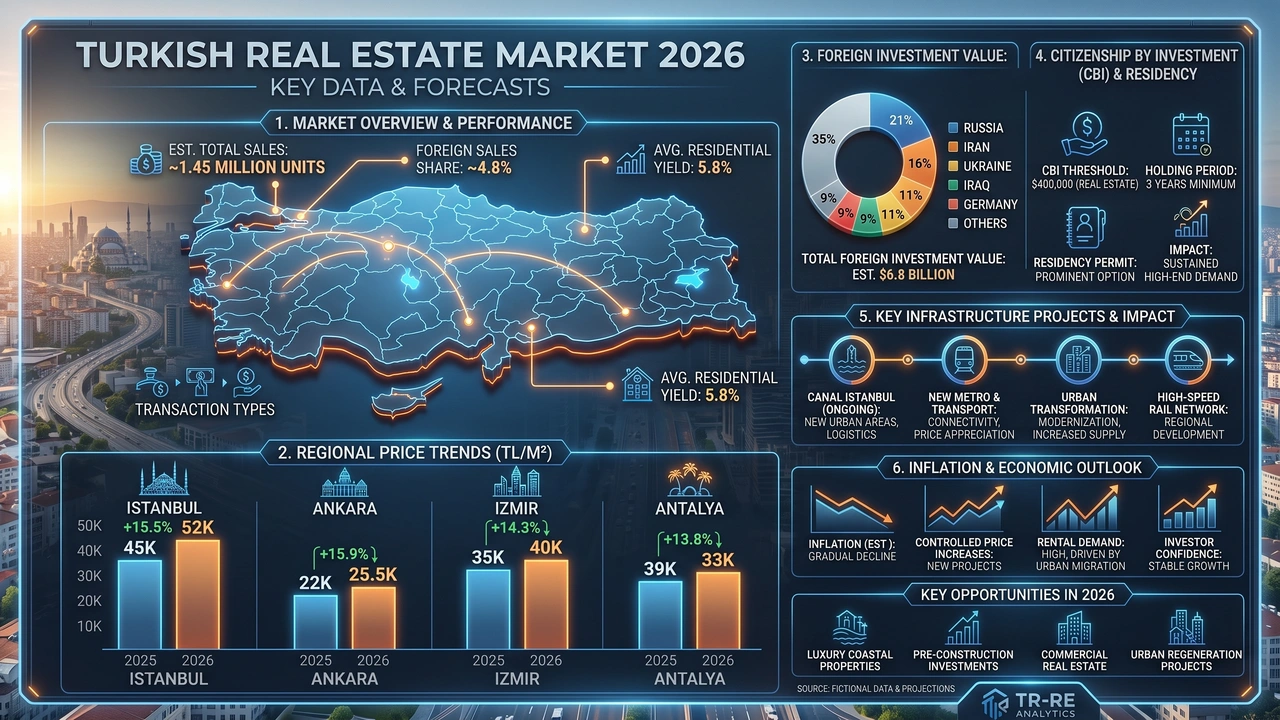
The real estate market in Istanbul represents one of the most prominent axes of real estate investment in Turkey, thanks to diverse residential demand, advanced infrastructure, and new urban projects. The city offers multiple options for foreign investors, from central properties to emerging areas, with differing prices, yields, and growth potentials, requiring careful study to choose the most suitable opportunity.
Why Does Real Estate Investment in Istanbul Remain Attractive?
The Istanbul real estate market retains a pivotal position thanks to the size of the local economy, residential demand, infrastructure, transportation, universities, tourism, and business centers. The city also combines a vast domestic market with international demand, which helps diversify demand sources. In July 2026, the real estate price index in Istanbul rose by 2.7% on a monthly basis, and by 27.7% on an annual basis, outperforming the national average of 25% in terms of annual nominal growth.
Best Areas for Real Estate Investment in Turkey
There is no single area that can be considered the best for all investors; the choice depends on the investment goal, budget, asset type, and holding period. However, areas of investment interest can be divided into categories:
Central Areas: Such as Beşiktaş, Şişli, and areas surrounding commercial centers, which are usually characterized by strong demand and high land values, but entry prices are higher and gross rental yields may be lower.
Asian Areas: Such as Kadıköy and parts of Maltepe, Kartal, and Üsküdar, where residential demand, good location, and development potential can be combined in some spots.
Growth and Development Areas: Include areas on the European and Asian sides that benefit from transportation and urban transformation projects, and may offer lower entry prices, but liquidity risks and excess supply must be analyzed at the project level and not just the area.
Apartment Prices in Turkey and Choosing the Property Type
Apartment prices in Turkey vary greatly between cities, neighborhoods, and even between buildings within the same neighborhood. Therefore, the city's average price alone should not be used to determine the fair value of a property. The price per square meter must be compared with similar properties in the building or neighborhood, reviewing the building's age, finishing quality, facilities, proximity to transportation, rental potential, maintenance fees, and the real estate developer's record. Discover the best areas to buy apartments and invest in real estate in European Istanbul 2026, and compare locations, prices, and returns to choose a more attractive investment apartment.
Evaluating Investment Risks and the Future of Real Estate in Turkey
Analyzing the Turkish real estate market requires a balanced assessment of opportunities and risks before making an investment decision. Inflation, exchange rate volatility, liquidity, and price disparities between regions affect the performance of real estate in Turkey. In contrast, infrastructure, residential demand, and urban transformation may support the future of real estate in Turkey and create promising investment opportunities.
Currency and Inflation Risks
The exchange rate of the Turkish lira is one of the most important risk elements for the foreign investor. A significant increase in the property's value in lira can coincide with a decrease or stabilization of its value when converted to dollars or euros. The July 2026 data clearly confirms this point: prices increased nominally by 25% year-on-year, but fell by 5.1% in real value. Therefore, the return model must be built using the currency in which the investor measures their wealth, not just the lira.
Liquidity and Resale Risks
Resale speed varies drastically depending on the area and the property. Properties with a strong location and diverse domestic demand may enjoy better liquidity, while some projects with high supply may face greater difficulty upon resale. Moreover, the 7.3% decrease in foreign sales during January–July 2026 indicates the necessity of not building an exit strategy on the assumption that there is always a foreign buyer.
Legal and Technical Risks
Before buying a property in Turkey, one must verify the title deed, registered restrictions, debts or mortgages, licenses, building condition, mandatory earthquake insurance for buildings, and official valuation when needed.
The official Invest in Türkiye platform clarifies that property registration procedures for foreigners require specific documents, including identity documents, Tapu, market value documents, and the mandatory earthquake insurance document, in addition to a sworn translator when not fluent in the Turkish language.
Turkish Real Estate Market Forecasts and the Future of Real Estate in Turkey
Turkish real estate market forecasts indicate that the upcoming phase may be different from the years of rapid nominal increases. Current indicators reflect a market where nominal prices are rising while real prices remain under pressure, with a relative improvement in some financing and demand indicators. Accordingly, it seems that the future of real estate in Turkey will be more linked to asset quality, its location, rental yield, urban transformation, infrastructure, and macroeconomic stability, rather than relying on price increases across the country as a whole. Discover where to find apartment prices in Turkey at more competitive rates, and learn about the best areas in Istanbul to buy reasonably priced apartments that combine ease of purchase, growth potential, and long-term investment.
Comparison Table of Turkish Market Opportunities and Risks
| Investment Factor | The Opportunity | Risk Level | What the Investor Should Check |
| Istanbul | Strong domestic and international demand | Medium, and prices may change depending on the area and demand volume | Neighborhood, transportation, price per m² |
| Central Properties | Liquidity and strong prestige | Medium, and high purchase prices may lead to a lower yield | Entry price and net yield |
| Development Areas | Lower entry prices and growth potential | Medium to high, and growth may be affected by delayed infrastructure and weak demand | Infrastructure and supply |
| Rental Properties | Periodic cash flow | Medium, and income may decrease due to property vacancy or rent changes | Actual rent and vacancy |
| Citizenship-Eligible Properties | Combines investment and citizenship option | Medium, requires compliance with legal conditions, and resale may be less flexible | Official valuation and holding condition |
| New Properties | Modern quality and facilities | Medium, delivery delays and high maintenance fees may affect the yield | Developer, delivery, maintenance fees |
| Existing Properties | Negotiation and resale possibility | Variable, and risks rise with the building's age and high maintenance costs | Building age and structural condition |
| Investment in Dollars | Clearer measurement of international yield | Relatively high, and the lira's depreciation may affect the yield when converted to foreign currencies | Exchange rate and exit price |
Steps to Make a Safer Investment Decision
- Determine the investment goal: Is the goal rental income, capital growth, residency, citizenship, personal use, or a combination of these goals? Determining the goal changes the choice of city, area, and property type.
- Compare the real price: Real estate prices in Turkey must be compared with similar properties using the price per square meter, rather than relying solely on the total price of the property.
- Calculate the net yield: Taxes, expenses, management fees, maintenance, and vacancy periods must be subtracted from the expected rental income to reach the net yield.
- Evaluate legal and technical risks: The Tapu, licenses, building condition, valuation, debts or restrictions, and compliance with regulations regarding foreign ownership should be examined.
- Build an exit strategy: The Turkish real estate market analysis does not end at the moment of purchase. You must know who the potential buyer will be upon selling, the time required to exit, and the impact of the exchange rate, fees, and taxes on the final return.
Discover the best areas to buy a property in Turkey, and learn how to choose the right city and area to achieve rental yield, growth opportunities, and a smarter investment.
Frequently Asked Questions: Turkish Real Estate Market Analysis and Evaluating Investment Opportunities and Risks
It can be suitable, but the opportunity depends on choosing the asset, the area, the purchase price, the net yield, and the risks associated with the exchange rate. The 2026 data indicates that the market has become more selective, so it is not enough to buy any property with the aim of benefiting from rising prices. The latest data shows that residential prices rose nominally by 25% annually until July 2026, but fell by 5.1% in real value. Also, total housing sales reached 823,119 units during January–July 2026, an annual decrease of 5.5%. There is no single answer for all investors. Istanbul has the deepest market and strong domestic and international demand, but entry prices in central areas may be higher. Therefore, the yield, risks, and liquidity must be compared with the investment goal. According to the official Invest in Türkiye platform, an eligible foreigner can apply for citizenship by purchasing a property worth at least $400,000, with a commitment not to sell the property for three years. The most prominent risks include lira exchange rate volatility, inflation, price disparity between regions, excess supply in some projects, and liquidity and resale risks, in addition to legal and technical risks. Therefore, a comprehensive inspection of the property must be conducted before buying, and one should not rely on price forecasts alone.
Conclusion: Are There Still Opportunities in the Turkish Real Estate Market?
The analysis of the Turkish real estate market in 2026 shows that the market is no longer solely based on nominal price increases, but has become more dependent on investment quality, location selection, and yield and risk analysis. Real estate in Turkey remains attractive to foreign investors thanks to market diversity, domestic demand size, Istanbul's position, the possibility of achieving rental income, in addition to the citizenship option according to official conditions.
However, real estate investment in Turkey requires dealing realistically with inflation, exchange rates, and liquidity; rising real estate prices in Turkey in lira does not necessarily mean achieving real gains in dollars or euros. The best areas for real estate investment in Turkey remain the areas where real demand, good infrastructure, fair price, construction quality, and rental and resale potential meet. In the Istanbul real estate market specifically, the best opportunities might be for the investor who focuses on precise analysis of the property and area rather than buying a property merely on the expectation that the entire market will rise.
For the foreign investor considering buying a property in Turkey, the most important question is not only "Will prices rise?", but rather "Does this property, at this price, and in this location, achieve a suitable return after accounting for all risks and costs?". This approach is the foundation for understanding the future of real estate in Turkey and transforming real estate investment opportunities in Turkey into more sustainable investment decisions.