Earthquake insurance in Turkey is one of the most important measures that property investors and buyers should understand before deciding to purchase an apartment or house, particularly given the seismic activity affecting different parts of the country.
Turkey has introduced a mandatory natural disaster insurance system known as DASK earthquake insurance in Turkey. Its purpose is to provide financial compensation for physical damage to residential buildings caused by earthquakes and certain related disasters.
The importance of property insurance in Turkey is not limited to meeting legal requirements and completing property transfer procedures. It also extends to protecting buyers against some of the potential financial risks that may arise after purchasing a property.
Therefore, understanding DASK requirements, the cost of DASK insurance in Turkey, the limits of insurance coverage, and the difference between compulsory earthquake insurance and additional home insurance helps buyers make more informed property decisions.
In this article, we explore the importance of earthquake insurance in Turkey before purchasing a property, how to obtain a policy, the insurance cost under the 2026 tariff, what the policy covers and excludes, and the checks that should be completed before signing a purchase agreement or registering the property in the buyer's name.
What Is DASK Earthquake Insurance in Turkey, and Why Is It Important Before Buying Property?
Compulsory earthquake insurance in Turkey is officially known as DASK. The name is an abbreviation of the Natural Disaster Insurance Institution (Doğal Afet Sigortaları Kurumu), which is responsible for administering this insurance system.
The Law Regulating DASK Insurance and the Nature of Insurance Coverage in Turkey
The system was established under Law No. 6305 on Disaster Insurance, with the aim of providing homeowners with financial protection against physical damage to residential properties caused by earthquakes.
This system differs from commercial home insurance because it is subject to officially determined rules, tariffs, and coverage limits. Policies are issued exclusively through insurance companies and authorized agents in Turkey.
Why Is Earthquake Insurance Important Before Buying Property in Turkey?
Earthquake insurance is important before buying property in Turkey for several key reasons:
- Financial protection: It compensates for damage to insured structural components resulting from earthquakes.
- Meeting legal requirements: Insurance is mandatory for residential properties covered by the system and is required when transferring ownership.
- Reducing investment risks: It helps buyers understand the level of financial protection available for the property.
- Facilitating official procedures: It helps complete property transactions and access certain essential services.
- Financial planning: It helps buyers estimate the annual insurance costs associated with owning a property.
Having a valid DASK policy does not mean that a building is structurally safe or has passed an engineering inspection. It provides financial insurance, not a building safety certificate.
Is DASK Insurance Mandatory When Buying Property in Turkey?
Yes. Compulsory earthquake insurance is required for properties covered by the system. As of September 5, 2026, a new DASK policy must be issued in the buyer's name before the ownership transfer is completed, in accordance with the applicable official procedures.
The seller's policy expires when the sale is registered, whether at the Land Registry Directorate or through a notary (Noter). Therefore, the buyer must obtain their own policy before completing the property transaction.
Discover everything you need to know about compulsory DASK earthquake insurance in Turkey, from the issuance requirements and insurance coverage to prices and ways to protect your property and real estate investment before making a purchase decision.
What Does Earthquake Insurance Cover for Properties in Turkey, and What Are Its Coverage Limits?
It is essential to understand the coverage details before relying on DASK as the only form of property protection. Compulsory insurance covers specific types of damage and does not include every loss a property owner may incur after an earthquake.
What Does Earthquake Insurance Cover in Turkey?
DASK covers direct physical damage caused by earthquakes and related events. Its insurance coverage includes the following building components:
- Building foundations.
- Main walls and shared walls between residential units.
- Retaining walls and garden walls.
- Roofs and floors.
- Stairs and corridors.
- Elevators and landings.
- Building rooftops and chimneys.
- Similar structural and supplementary components.
The coverage includes both partial and total building damage, subject to the insured amount specified in the policy.
What Damage Is Not Covered by DASK Insurance?
Compulsory insurance does not provide comprehensive compensation for all earthquake-related losses. The main exclusions include:
- Furniture, electrical appliances, and movable personal belongings.
- Debris removal costs.
- Rental losses or loss of income resulting from the property's inability to be used.
- Alternative accommodation and temporary housing expenses.
- Bodily injuries and fatalities.
- Non-material damages and indirect financial liabilities.
Damage caused by the building's own defects that develop over time, where such damage is not directly caused by an insured risk.
For this reason, it is advisable to obtain additional home insurance covering furniture, personal belongings, and risks excluded from DASK.
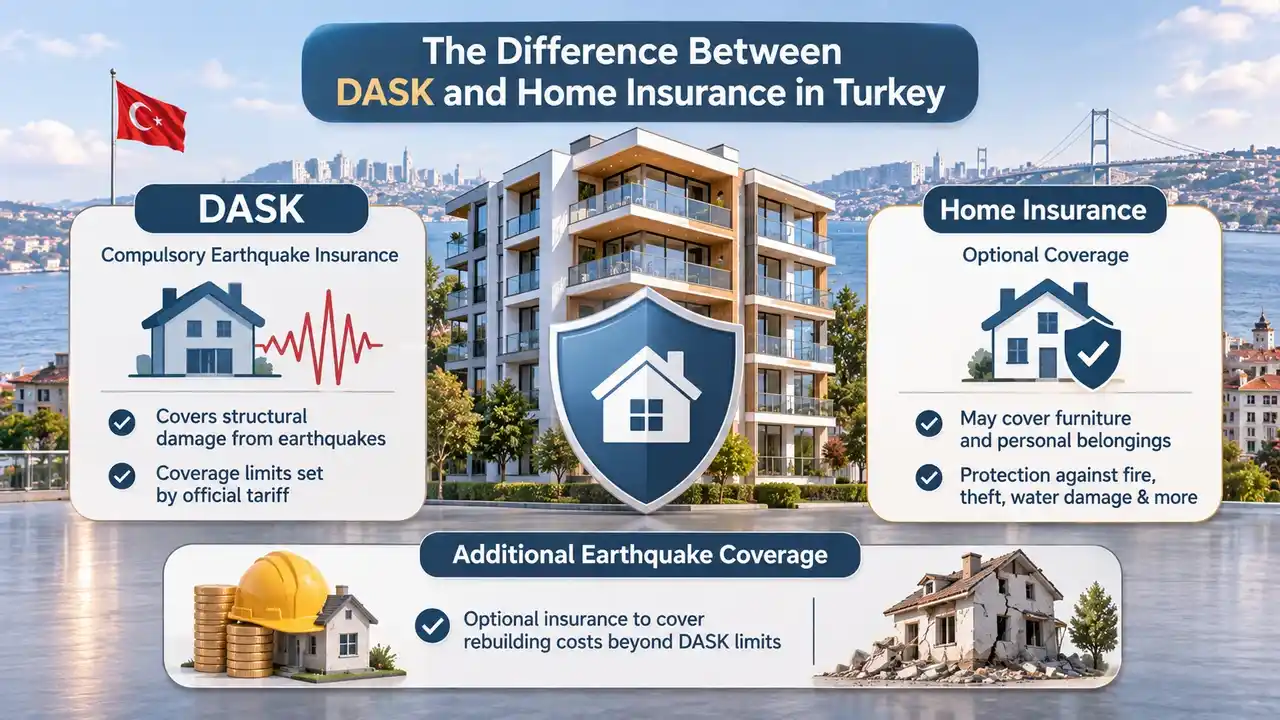
The Difference Between DASK and Home Insurance in Turkey
Compulsory earthquake insurance and optional home insurance differ in their scope of coverage. The former focuses on structural damage caused by earthquakes, while the latter can provide broader protection depending on the policy terms. The main differences include:
- DASK: Compulsory insurance for properties covered by the system, with coverage limits determined by the official tariff.
- Home insurance: Optional insurance that may cover furniture, personal belongings, fire, theft, water damage, and other risks.
- Additional earthquake coverage: Additional insurance can be purchased to cover rebuilding costs exceeding the maximum DASK coverage limit.
Therefore, combining compulsory insurance with additional home insurance may provide broader financial protection for property owners.
Learn about the engineering standards and essential specifications for earthquake-resistant building design in Turkey, and how understanding construction quality can help you choose a safer property before making your final selection.
Looking for a reliable real estate platform to sell your property quickly and transparently?
EmlakPlatform is not just an option, it is the smart solution for you. We combine advanced technology, full transparency, and professional support
DASK Insurance Prices in Turkey in 2026 and the Factors Affecting the Cost
The cost of DASK insurance in Turkey varies depending on the property. Its price is determined by factors such as location and seismic risk category, structural system, floor area, building permit year, and number of floors.
Earthquake Insurance Costs in Turkey Under the Official Tariff
According to the official tariff effective November 1, 2026, the approved reconstruction costs used to calculate the insured amount are:
Reinforced concrete buildings: TRY 12,288 per square meter.
Buildings constructed using other structural types: TRY 8,192 per square meter.
The insurance value is calculated by multiplying the property's area by the approved reconstruction cost per square meter, then applying the risk rate based on location and building type.
What Factors Affect the Cost of DASK Insurance in Turkey?
Several factors affect the cost of insurance, including:
The property's geographical location: Turkish regions are classified into seven risk groups according to location and risk level.
Building type: Different tariffs apply to reinforced concrete buildings and other structural types.
Year the building permit was issued: A 10% surcharge applies to buildings whose construction permits were issued before 2000.
Number of floors: Tariff adjustments apply to reinforced concrete buildings:
A 10% discount for buildings with no more than three above-ground floors.
A 10% surcharge for buildings with eight or more above-ground floors.
Policy renewal: A 20% renewal discount is granted when the policy is renewed within 30 days of its expiry date, subject to the applicable conditions.
What Is the Maximum DASK Coverage Limit in 2026?
Under the official tariff, the maximum insurance coverage for a single property is TRY 2,605,100 as of November 1, 2026. The insured amount is calculated based on the property's reconstruction cost, excluding the land value, and cannot exceed the prescribed maximum limit.
An apartment's market value may exceed the maximum DASK coverage because the insurance is based on reconstruction costs rather than the purchase price or land value. Additional insurance can be purchased to cover the remaining amount.
Discover how earthquakes have affected the real estate market in Istanbul and Turkey, and the criteria you should consider before purchasing a property to make a more informed investment decision.
DASK Insurance Requirements in Turkey and How to Obtain a Policy Before Buying Property
Buyers need to understand DASK insurance requirements in Turkey and the information required to issue a policy, particularly when purchasing a property for the first time or planning to register ownership in their name.
DASK Insurance Requirements in Turkey
The compulsory insurance system covers certain buildings and property units that meet the legal requirements. These include:
- Residential buildings registered in the Land Registry and subject to private ownership.
- Apartments and independent units subject to the Condominium Law No. 634.
- Independent units used for commercial or office purposes within buildings covered by the system.
- Residential buildings constructed by the state or through government funding related to natural disasters.
- Buildings with condominium construction easement rights (Kat İrtifakı), subject to the specified conditions.
Certain properties whose classification procedures in the Land Registry have not been completed, in accordance with the institution's regulations.
Buildings Excluded from DASK Insurance and Alternative Insurance Options
Certain buildings are excluded from compulsory insurance, such as industrial and commercial facilities, buildings lacking approved projects or engineering services, buildings scheduled for demolition, and certain structurally non-compliant properties under the applicable legal regulations.
Exclusion from DASK does not necessarily mean that these buildings cannot be insured. Optional insurance solutions may be considered depending on the property's nature, structural condition, and the coverage terms offered by insurance companies.
How to Obtain DASK Insurance in Turkey
A DASK policy can be obtained through authorized insurance companies and their agents, as well as through channels provided by participating financial and insurance institutions. The process generally involves the following steps:
Step 1: Prepare the Policyholder's Information
The applicant must provide the policyholder's personal details, including their full name and Turkish identity number or tax identification number, depending on their legal status.
A valid phone number and basic contact information should also be provided to ensure that the insured person's details are accurate and to facilitate the policy issuance and follow-up procedures with the insurance company.
Step 2: Prepare the Property Details
Property information includes the full address, the ten-digit National Address Code (Adres Kodu), title deed information (Tapu), the year of construction or building permit issuance, the structural system, and the number of floors.
The information also includes the apartment's gross area in square meters, the building's structural condition, and the intended use of the residential unit. These details help ensure that the insured amount and annual premium are calculated accurately.
Step 3: Calculate the Insurance Amount
The property details are reviewed carefully to determine the insured value based on the gross floor area, structural system, and building location, in accordance with the standards approved by the official DASK institution.
Based on this information, the annual insurance premium is calculated according to the official tariff and seismic risk group, taking into account any applicable discounts and surcharges.
Step 4: Issue the Policy and Pay the Premium
After reviewing the policyholder's and property's information and confirming that it meets the official requirements, the insurance company calculates the premium due and determines the coverage amount according to the tariff approved by DASK.
Once the application is approved, the policy is issued in the insured person's name. The annual premium is then paid using the payment methods available through the insurance company or authorized agent to complete the issuance process.
Step 5: Review the Policy
The policy details must be checked to ensure that the policyholder's name, property address, National Address Code, total area, and building type are correct, along with the insurance start and expiry dates.
Accurate information is particularly important because the DASK system relies on the details provided when the policy is issued. Errors or incorrect declarations may result in reduced compensation or financial losses for the insured person.
Learn about the main legal, structural, and financial risks of buying property in Turkey, and the essential verification procedures that can protect you against fraud and losses before completing a transaction or signing a purchase agreement.
Buying Property in Turkey and Earthquake Insurance: What Should You Check Before Signing the Contract?
When buying property in Turkey, earthquake insurance should not be treated as a mere administrative requirement. Instead, it should be included as part of the property's legal, technical, and financial due diligence.
Having a valid DASK policy does not prove that a building is earthquake-resistant or confirm the quality of its foundations, columns, or reinforced concrete beams. Therefore, insurance verification must be combined with an inspection of the building's structural condition.
Checking Earthquake Insurance Before Buying an Apartment in Turkey
Before completing the purchase, it is advisable to review the following points:
- Check whether a DASK policy exists: Ask the seller for a copy of the policy, and verify its number, validity, and consistency with the property's details.
- Match the property details with the title deed: Compare the address, unit number, and area stated in the insurance policy with the title deed.
- Review the construction year: Verify the year the building permit was issued, particularly when purchasing older properties.
- Verify the structural system: Confirm the type of structural system and whether it complies with the approved engineering plans.
- Arrange an independent engineering inspection: Hire an engineer to inspect the building, its columns, load-bearing walls, and any potential structural violations.
- Review the site's risks: Check the seismic risk level and soil conditions in the area before deciding to purchase.
- Issue a new policy in the buyer's name: Since September 5, 2026, DASK must be issued in the buyer's name before transferring ownership at the Land Registry or through a notary.
Does Having DASK Mean That a Property Is Safe Against Earthquakes?
Insurance provides limited financial protection when damage occurs, but it does not assess a building's earthquake resistance or structural safety. An older building may have a valid DASK policy despite requiring a detailed engineering inspection. Therefore, a property purchase decision should be based on three complementary areas:
- Legal considerations: The validity of the title deed, permits, and the property's legal status.
- Engineering considerations: Construction quality, foundations, structural framework, and soil conditions.
- Insurance considerations: The existence of a valid and accurate DASK policy and the need for additional coverage.
Combining these areas helps reduce risks and clarify the property's actual condition before paying for it or transferring ownership.
Learn about the legal procedures and documents required to buy property in Turkey, and how to review ownership and complete the title deed transfer with confidence before paying for the property, avoiding delays and additional costs.
Comparison Table: Earthquake Insurance and Home Insurance in Turkey
| Comparison Criteria | DASK Insurance | Home Insurance |
| Type of insurance | Mandatory for properties covered by the system | Optional |
| Regulating institution | DASK Institution | Insurance companies |
| Earthquake damage coverage | Yes, within official limits | Subject to policy terms |
| Structural damage | Yes | Subject to coverage |
| Furniture and appliances | No | Can be covered |
| Fire | When caused by earthquakes | Subject to the policy |
| Theft | No | Can be covered |
| Water damage | Not included in basic coverage | Can be covered |
| Alternative accommodation costs | No | Can be covered |
| Maximum coverage | TRY 2,605,100 in November 2026 | According to the agreed insured amount |
| Insurance period | One year | According to the policy term |
| Additional coverage options | Through optional insurance | Subject to the company's terms |
Frequently Asked Questions About Earthquake Insurance for Property in Turkey
Yes, compulsory earthquake insurance applies to properties covered by the scheme, and Turkish citizenship is not a requirement for obtaining the policy. Foreign buyers must issue a policy in their own name before completing the sale registration, in accordance with the procedures in effect since September 5, 2026.
There is no single fixed price for all properties. The cost is determined by the property's area, building type, and earthquake risk category. For example, the indicative premium for a 100-square-meter reinforced-concrete apartment in the first risk category is TRY 3,465, according to the November 2026 tariff, before any potential discounts or surcharges.
No, DASK does not cover furniture, electrical appliances, or movable personal belongings. These items require additional home insurance that includes suitable coverage for household contents.
A preliminary agreement or a promise-to-sell contract may be signed in accordance with legal requirements. However, completing the sale registration for a property covered by the DASK system requires a valid policy in the buyer's name, under the update that has been in effect since September 2026. Therefore, the insurance should be arranged before the ownership transfer appointment.
No, because coverage is limited to the direct physical damage included in the policy, up to an officially specified maximum amount. It does not cover furniture, indirect losses, or all reconstruction costs if they exceed the available coverage limit. Therefore, DASK can be combined with optional home insurance to obtain broader protection.
Conclusion: Earthquake Insurance for Property in Turkey and Its Role Before Purchasing
Earthquake insurance for property in Turkey and its role before purchasing are essential considerations for investors and buyers. DASK insurance not only meets the legal requirements for transferring ownership but also provides financial protection against earthquake damage within the approved coverage limits.
In this article, we have reviewed DASK insurance requirements in Turkey, how to obtain a policy, insurance prices and costs under the 2026 tariff, covered damage and exclusions, and the differences between compulsory earthquake insurance and optional home insurance.
However, the importance of earthquake insurance before buying property in Turkey does not eliminate the need for an independent engineering inspection of the building and verification of construction quality, structural safety, and soil conditions. Having a valid insurance policy does not necessarily mean that a property is structurally safe.
A sound property purchase decision therefore combines legal due diligence, a review of the DASK policy, an engineering assessment, and the selection of appropriate insurance coverage. These steps help buyers make informed decisions and reduce the financial risks associated with owning property in Turkey.